Online Baccarat in New Zealand: Rules and Play
 Available in US
A practical guide to baccarat scoring, betting options, online casino checks, and the differences between live dealer and automated games.

Table of Contents
- How Baccarat Hands Are Scored
- Player, Banker and Tie Bets: Payouts and House Edge
- What to Check When Comparing Online Baccarat Casinos
- New Zealand’s 2026 Online Casino Licensing Transition
- How an Online Baccarat Round Works
- Free Baccarat and Real-Money Play: What the Evidence Establishes
- Playing Baccarat Online Across Devices
- Crypto Baccarat: What Can Be Confirmed
- Live Dealer Baccarat and Automated Games
- Can Baccarat Be Cheated or Beaten Online?
How Baccarat Hands Are Scored
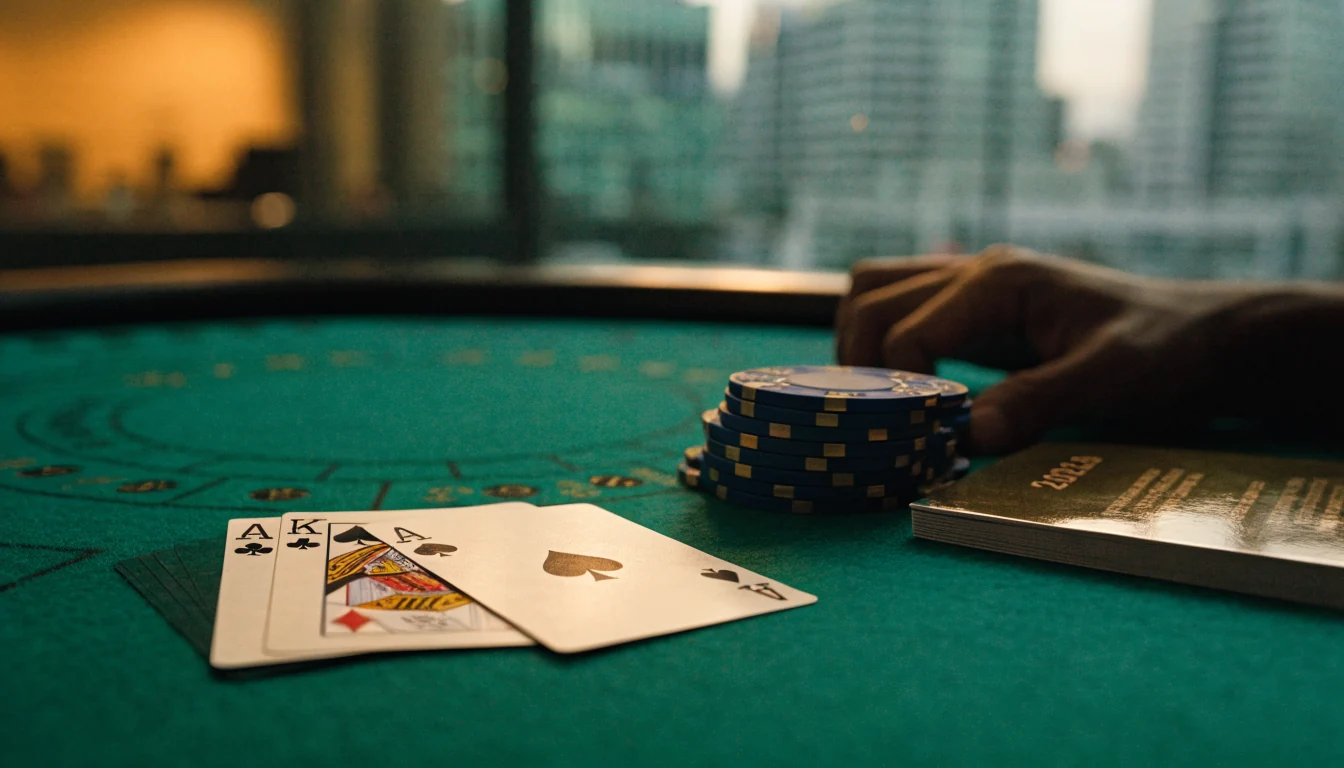
In the traditional Punto Banco form of baccarat, the value of a hand is determined by its cards, but not by adding them in the same way as in many other card games. Aces count as one, cards from two through nine retain their face values, and tens and face cards count as zero. Once the card values are added, only the final digit of the total is used as the hand’s value.
This last-digit rule is central to understanding baccarat. The full sum is not carried forward as the score: the hand is read by its units digit. If the cards add to a total ending in six, for instance, the hand’s value is six. A total ending in zero has a value of zero. The calculation therefore turns an ordinary sum into a single-digit score, with the tens portion discarded.
The card values can be considered in three groups. Aces contribute one point each. Number cards from two to nine contribute the number printed on them. Tens, jacks, queens and kings contribute nothing. A zero-value card still belongs to the hand, but it does not increase the sum. Several zero-value cards can therefore appear without changing the total produced by the other cards.
Choosing an online baccarat site in New Zealand involves checking what is known about its licensing and other available details. This list offers a concise reference to help you assess the information provided for each operator.
License: Tobique Gaming Commission, licence no. 0000064 Neospin lists a licence from the Tobique Gaming Commission, licence no. 0000064.
License: Tobique Gaming Commission, licence no. 0000002 Ricky Casino lists a licence from the Tobique Gaming Commission, licence no. 0000002.
License: Curaçao Gaming Authority, licence no. OGL/2024/165/0185 BitStarz lists a licence from the Curaçao Gaming Authority, licence no. OGL/2024/165/0185.
License: Tobique Gaming Commission, licence no. 0000091 7Bit Casino lists a licence from the Tobique Gaming Commission, licence no. 0000091.
License: Malta Gaming Authority, licence no. MGA/B2C/370/2017 Play Grand lists a Malta Gaming Authority licence, no. MGA/B2C/370/2017.
Payout speed: 1-3 business days Wintino’s stated payout speed is 1–3 business days.
Payout speed: 1-3 business days Lamabet’s stated payout speed is 1–3 business days.
License: 07017519840 · Payout speed: 1-3 business days Zotabet lists licence number 07017519840 and a stated payout speed of 1–3 business days.
License: Malta Gaming Authority, licence no. MGA/B2C/394/2017 N1 Casino lists a Malta Gaming Authority licence, no. MGA/B2C/394/2017.
For example, an ace and a seven make a total of eight, so the hand is valued at eight. Adding a king does not change that value, because the king counts as zero. By contrast, adding a two changes the sum to ten; under the final-digit rule, the resulting hand value is zero. These examples illustrate why both the card values and the final digit matter: the sum is calculated first, then reduced to the value represented by its last digit.
The same calculation applies regardless of the cards’ suits. Hearts, diamonds, clubs and spades do not carry different point values, and a suit combination does not alter the hand’s result. Scoring depends on the card ranks and the final digit of their total, not on whether the cards share a suit or form a particular suit pattern.
Punto Banco is the most established and commonly played baccarat variant, and its shoe contains six to eight decks. Using multiple decks does not change the value assigned to an individual card: an ace still counts as one, a nine as nine, and a face card as zero. The scoring method remains consistent across the cards dealt from the shoe.
These rules provide the arithmetic basis for baccarat, including versions played online. A displayed hand value is not a separate measure or an estimate; it follows from the assigned card values and the last-digit calculation. Suits have no bearing on that calculation.
Player, Banker and Tie Bets: Payouts and House Edge
A standard baccarat table offers three main wagers: Player, Banker and Tie. Each is a prediction about the hand result, but the payouts and the house edge differ substantially. For real-money online baccarat, those figures are central to comparing the mathematical cost of the available bets; they do not indicate which result will occur in a particular round.
| Bet | Payout | House edge |
|---|---|---|
| Player | 1:1 | 1.24% |
| Banker | 0.95:1 after 5% commission | 1.06% |
| Tie | 8:1 | 14.36% |
These house-edge figures apply to an eight-deck game with a 5% commission on Banker winnings. The house edge is a theoretical measure of the casino’s long-run advantage on a wager, expressed as a share of the amount staked. It is not a fee taken from every bet, nor a forecast of an individual session. A result in a single hand can differ from the long-run expectation.
Player: even-money payout
A Player wager pays 1:1. In payout terms, a winning bet returns winnings equal to the stake, in addition to the return of the stake itself. Its house edge is 1.24% under the stated conditions.
The label refers to the Player hand, rather than to the person placing the wager. This distinction matters in an online baccarat casino game, where the bet is a selection among the available outcomes, not a way to influence how the cards are dealt. The Player option therefore has a clear payout structure, while its house edge provides a separate measure of its theoretical cost.
A Player wager refers to the Player hand outcome, not the person placing the bet, and it pays 1:1 with a house edge of 1.24%.
Banker: lower edge, commission-adjusted return
A Banker wager has the lowest of the three stated house edges, at 1.06%. Its payout is not a full 1:1: after a 5% commission, a winning bet pays 0.95:1. The commission reduces the winnings, while the stake is treated separately from those winnings.
This pairing is important when interpreting the table. Looking only at the house edge would omit the commission condition that accompanies the quoted Banker payout. Conversely, focusing only on the reduced return would not capture the full mathematical comparison. The 1.06% figure already describes the edge under the stated eight-deck and commission conditions.
For baccarat casino games online, the Banker wager is therefore the lowest-cost option by the stated house-edge measure, but that does not make it a guaranteed or uniformly profitable choice. The edge describes the long-run relationship between the wager and the game, not the outcome of a particular hand.
Tie: larger payout, much higher edge
A Tie wager pays 8:1, the largest quoted payout among the three bets. Its house edge, however, is 14.36%, markedly higher than the figures for Player and Banker. The larger return on a winning Tie bet should therefore not be read as evidence that the wager is more favourable overall. Payout size and house edge describe different things: one specifies the return when a bet wins, while the other expresses the casino’s theoretical advantage over time.

This distinction is useful when comparing online baccarat casinos for real-money play. A prominent payout can attract attention, but the house edge gives a more direct basis for comparing the expected mathematical cost of different wagers. The stated figures place Tie well above the other two options on that measure.
Reading the comparison
Among these standard bets, Banker has the lowest stated house edge, followed by Player, with Tie carrying the highest. That ordering concerns the mathematical terms of the wagers, not a prediction of which option will win next. It also does not establish that every online table uses the same conditions: the quoted comparison is specifically tied to an eight-deck game and a 5% Banker commission.
Claims about online baccarat tricks should be treated with the same distinction in mind. The payout table can show the return attached to a winning wager and the house edge associated with the stated rules. It does not turn a wager into a method for controlling the result or removing the casino’s theoretical advantage. For a baccarat casino online, these figures are most informative when the payout, commission and applicable house edge are considered together.
What to Check When Comparing Online Baccarat Casinos
A useful comparison of online baccarat casinos starts with evidence about the game actually offered, rather than broad claims that an online casino is “best”. Availability, format and rules should be identifiable from the operator’s own materials before any judgement is made. A name appearing in a search result or a promotional description is not, by itself, evidence that baccarat can currently be played there.
Comparing Online Casinos
- Confirm baccarat is listed in the game lobby
- Verify the game is accessible and playable
- Check the rules and information panel for the specific version
- Identify the available wager options and payout conditions
Confirm that baccarat is available
The first check is whether baccarat appears in the online casino’s game lobby and whether its listing leads to an accessible game. A general casino description may mention table games without establishing that baccarat is included. Where the game is listed, its rules or information panel can help confirm what version is presented and what a player is being asked to bet on.
Punto Banco is the most common traditional form of baccarat, and the standard game offers Player, Banker and Tie wagers. These details provide a basis for checking whether an operator’s description matches the familiar format. If a listing gives little more than a game name, the available evidence may not be enough to compare its rules or conditions with another listing.
A comparison should distinguish what an operator states from what can be observed in the game interface. A promotional claim is not equivalent to a rules page, and a lobby entry does not establish every detail of the table. Keeping those forms of evidence separate makes it less likely that an unsupported description will be treated as a confirmed feature.
Examine the game information, not just its presentation
Useful material includes the rules shown before play, the available wager options and any stated payout conditions. These disclosures make it possible to check whether the presentation is consistent with the game’s stated rules. The comparison need not reproduce every rule; the point is that material conditions should be available clearly enough to assess.

A polished design, familiar terminology or video presentation does not establish that a game has different rules or a lower cost of play. Baccarat’s standard dealing decisions are governed by fixed rules, not by a player’s choice. Assessments should therefore focus on published game information rather than suggestions that a particular interface gives the player control over how cards are dealt.
The same care applies to claims about special features. If an operator describes an additional wager or a distinct table format, the feature should be identifiable in its own game information. It should not be inferred merely from a broad label such as “live baccarat” or “premium table”. Where terms are not explained, the comparison should record that uncertainty rather than assume what they mean.
Separate live presentation from claims about quality
A live casino listing and an automated game are different ways of presenting baccarat. The distinction can be checked by looking at how the game is described: live dealer baccarat uses a real dealer and physical cards streamed by video, while automated baccarat uses a random number generator. That difference concerns delivery; it does not, on its own, establish that one format is fairer or more favourable.
Likewise, a provider name or a dealer-led presentation is not sufficient evidence for claims about reliability, value or superiority. Such claims require supporting information. The house edge is identical for live dealer and automated baccarat, so the format alone is not a sound basis for saying one has a lower house edge.
Comparison language should remain proportionate to what is shown. “Best” is not a measurable property unless the criteria are stated. A defensible assessment might describe whether rules are accessible and whether the offered format is clearly identified. It should not turn those observations into an unsupported ranking of online casinos or live tables.
- Focus on published game information
- Identify the specific table format (live or automated)
- Separate observable data from marketing language
- Rely on polished design as evidence of lower costs
- Assume “live baccarat” implies specific special features
- Use provider names as sole evidence of reliability
Consider the New Zealand context accurately
The player-side legal position should not be confused with the rules imposed on providers. Players are not penalized for continuing to use unlicensed online casinos. That does not mean that every operator is authorised to serve New Zealand, nor does it establish that an operator complies with the requirements applying to providers. The status of an operator and the consequences of operating without the required permission are separate questions from whether a player faces a penalty.
This distinction matters when evaluating claims about licensing. In 2026, the domestic licensing framework is in transition, and no operator holds a New Zealand Department of Internal Affairs licence during that year. A comparison should not describe an offshore operator as holding a New Zealand licence unless that status is established. Nor should the absence of a player penalty be presented as approval or endorsement of a casino.
For Kiwi assessing an online casino, the sounder approach is to separate observable baccarat information from legal claims and marketing language. Check whether the game is actually listed, whether its format and rules are explained, and whether claims about its qualities have supporting detail. Where those elements cannot be established, the casino cannot be compared confidently on that point.
New Zealand’s 2026 Online Casino Licensing Transition
The Online Casino Gambling Act 2026 introduced a domestic licensing framework for online casino gambling. It came into force on 1 May 2026, beginning a transition from a market in which online casinos operating from overseas were not licensed or supervised by a New Zealand regulator. The new system is intended to establish which providers can serve Kiwi players under a New Zealand licence.

The change concerns the legal status of operators, not the rules of baccarat itself. A provider’s ability to offer online baccarat in New Zealand during 2026 depends on the transition provisions and, later, on its licensing position. The Act does not mean that licensed operators were already in place when it took effect: no operator held a Department of Internal Affairs (DIA) licence in 2026.
Who may continue during the transition
The Act allows online casinos that were already serving New Zealand before 1 May 2026 to continue operating until 1 December 2026. This is a temporary provision for existing operators, not a general route for new providers to enter the market during that period.
A further condition applies from 1 December. After that date, an operator may continue under a temporary exemption only if it has applied for a licence and its application is still under consideration. The transition therefore distinguishes between providers covered by the initial period and those able to remain while an application is assessed. An operator outside the relevant conditions cannot rely on the temporary exemption to continue serving New Zealand.
The key dates mark different stages of the framework: 1 May 2026 was the Act’s commencement, while 1 December 2026 marks the end of the initial continuation period for operators already active before commencement. It is not accurate to treat the first date as meaning that the licensing system was already fully populated, or the second as an automatic licence for every provider that had previously operated.
Licensing Warning
No operator held a New Zealand Department of Internal Affairs licence in 2026; offshore operators should not be described as holding a domestic licence.
Licence numbers and the 2026 position
The framework provides for up to 15 online casino licences to be issued to qualified operators. This is a maximum, not a statement that that number of licences had been granted in 2026. Since no operator held a DIA licence during that year, the transition must be understood separately from the future licensed market.
For someone assessing an online baccarat casino, the practical distinction is between a provider’s status during the transitional period and its eventual licence status. Continued operation under a temporary exemption is not the same as holding a New Zealand licence. Equally, the existence of the licensing framework does not establish that any particular casino has been approved.
The Act establishes the domestic system, but the full licensed regime is not expected to be fully operational until 2027. Until then, the transition provisions determine which existing providers may continue and on what basis. From 1 December 2026, the relevant temporary exemption is limited to operators with an application under consideration; it does not convert those operators into licensees.
This makes 2026 a changeover year for online casino services in New Zealand. The dates and conditions matter more than broad labels such as “licensed” or “available”: a casino operating during the transition may be doing so under a temporary arrangement, while the licensing framework is still being put into effect.
How an Online Baccarat Round Works
A standard online baccarat round follows a set sequence: wagers are placed, cards are dealt to the Player and Banker hands, and the result is determined by the rules of play. The player’s decision is made before the deal. Once cards are in play, the player does not choose whether either hand receives another card.

Before dealing begins, the available main wagers are Player, Banker and Tie. Each represents a different prediction: that the Player hand will finish closer to nine, that the Banker hand will finish closer to nine, or that both hands will end in a tie. The wager must be selected before the cards are dealt; it cannot be changed to match what appears during the round. This is the basic structure of baccarat play online, whether the game is presented through a digital table or another online format.
The opening deal gives each hand two cards. Their values are assessed under baccarat’s rules, and the hands are compared. The result may already be settled at this point. In particular, if either hand has a total of eight or nine after its first two cards, dealing stops. These outcomes are often called naturals. Neither hand receives another card in that case.
If neither hand has reached that stopping point, the round may continue with a third card. The decision is not made by the person who placed the wager. Fixed rules determine whether a third card is drawn, and those rules can depend on the cards already dealt. As a result, the sequence is not a matter of choosing to hit or stand, as it is in some other card games. Online baccarat play is therefore largely a matter of selecting a wager before the deal and then following a predetermined hand progression.
Baccarat Round Sequence
Select a bet on Player, Banker, or Tie before any cards are dealt.
Two cards are dealt to both the Player and Banker hands and their values are assessed.
If either hand totals eight or nine, the round ends immediately without further cards.
If no natural occurs, fixed rules determine if a third card is drawn for either hand.
The final totals are compared to determine the winning wager.
The third-card procedure is designed to resolve the round consistently. A hand may draw or stand according to the rules, and the other hand’s action may be affected by the cards in the first hand. The full decision table is detailed; the important point for understanding the round is that the rules, rather than player input, govern each draw. A player’s initial wager does not alter the dealing procedure.
After any required cards have been dealt, the two hands are compared. The wager wins if its selected outcome matches the result: Player or Banker is closest to nine, or the hands tie. The round then ends, and a new one begins with wagers placed before another deal. No strategic choice during dealing can redirect the cards or change the fixed draw rules.
This sequence also clarifies what “how to play online baccarat” means in practice. It does not require a series of decisions about individual cards. The central action is placing one of the standard wagers before dealing; the subsequent play is determined by the game’s rules. An online display may present the cards and result in different ways, but the underlying round still depends on the wager, the deal and the fixed procedure for deciding whether another card is taken.
Free Baccarat and Real-Money Play: What the Evidence Establishes
“Free baccarat” can describe different things: a demonstration game with no cash wager, a practice mode, or a game in which a player risks money. Those descriptions are not interchangeable. The availability of one does not establish that the others are offered, or that a particular online casino provides any of them.

The established Punto Banco format has a defined structure: bets are placed on Player, Banker or Tie before the cards are dealt, and the rules determine whether a third card is drawn. That describes the game, not its price or mode of access. A baccarat simulator would need to reproduce those mechanics to simulate the standard game, but the existence of baccarat rules alone does not establish that a free simulator is available.
The same distinction applies to claims about playing without downloading software. A game’s format and its method of access are separate matters. The rules do not show whether a particular title runs in a browser, requires an application, or offers a no-download option. Those details need to be established for the specific product rather than inferred from the word “online”.
A free mode, where one is offered, should not be treated as evidence about real-money play. A practice setting would not by itself establish what wagers are accepted, what payment methods are supported or whether the game uses the same interface as a cash game. Conversely, the existence of a real-money baccarat table would not show that a free version is available. Claims about either mode require product-level support.
The game’s rules also do not amount to an online baccarat strategy. Knowing that the standard wagers are Player, Banker and Tie, or that card dealing follows fixed rules, describes how a round operates. It does not establish a method that changes the outcome or guarantees a return. A simulator could help illustrate the sequence of a hand, but no particular simulator or training function can be inferred from the game mechanics alone.
Attention: A free-play or practice mode does not establish the availability of real-money play, accepted payment methods, or the use of the same interface as cash games.
This distinction is useful when assessing phrases such as “free play” or “practice game”. They are not precise descriptions of how a product works. A claim is clearer when it identifies whether cash is wagered, whether the game follows standard Punto Banco rules and whether the mode is actually available from the named provider. Without those particulars, a label alone does not establish what a player would encounter.
For Kiwi players, the defensible conclusion is narrow: baccarat has defined rules that can be described independently of any free-play feature. Whether a specific online casino offers free baccarat, what that mode includes, and whether it can be used without a download are separate product claims. They should not be presented as established merely because a real-money baccarat game exists, or because the game’s rules can be explained.
Playing Baccarat Online Across Devices
Online baccarat is available across three broad device categories: desktop or laptop computers, tablets and smartphones. This describes where the game can be played, rather than implying that every online casino offers the same interface or access method on each device.
A computer provides a larger display area for the table and its on-screen controls. That may make the layout easier to view at a glance, particularly when several pieces of game information appear together. A tablet offers a middle ground in screen size, while a smartphone makes baccarat accessible on a smaller, portable screen. These are differences in the device, not changes to baccarat itself.

The choice of device does not alter the underlying game rules. Baccarat remains the same game whether accessed on a computer, tablet or phone. The device determines how the available interface is presented, while the game determines how a round proceeds. This distinction matters because an experience that is suitable on one screen cannot be assumed to look or function identically on another.
Searches for ways to play baccarat online without downloads raise a separate question from which devices support the game. Device compatibility alone does not establish whether a particular online casino uses a browser-based version, requires an application, or offers both. Nor does it establish that a free version is available on every device. Those details depend on the specific service and should not be inferred from the fact that baccarat can be played on PCs, tablets and smartphones.
The same caution applies to the phrase “real baccarat online”. It can refer to different expectations, including an authentic version of the game or play involving money. The device category by itself confirms neither. Access from a phone, for instance, does not prove that a particular table is available there, or that its terms match those on a computer.
For a clear comparison, device access should therefore be treated as a basic availability question: whether baccarat can be played through a computer, tablet or smartphone. Claims about downloads, apps, free access or identical features across screens require separate evidence.
Crypto Baccarat: What Can Be Confirmed
“Crypto baccarat” can refer to two different things: an online baccarat game and a payment arrangement involving cryptocurrency. The label alone does not establish that an online casino accepts crypto, supports deposits or withdrawals in it, or makes baccarat available to Kiwi customers. Those are operator-specific matters, not properties of the game itself.
The label “crypto baccarat” refers to either the game or the payment method, but it does not inherently change baccarat rules, such as the fact that suits do not affect the outcome.
The baccarat rule that can be stated independently of payment method is that suits do not affect the outcome of a hand. Whether a game is presented online or described as crypto baccarat does not, by itself, change that rule. Nor does the presence of a baccarat table show what currency or payment method an operator accepts.
This distinction matters when assessing claims about crypto-funded play in New Zealand. A description of baccarat mechanics is not evidence of crypto payment support, while a reference to cryptocurrency does not establish which games an operator offers. Availability should therefore not be inferred from a product label or from general descriptions of online baccarat.
The same caution applies to claims about deposits and withdrawals. Without information tied to a particular operator and its current terms, statements about whether crypto can be used, or how such transactions work, cannot be treated as established. No general conclusion about crypto baccarat availability in New Zealand follows from the rules of baccarat.

For Kiwi, the useful distinction is between the game and the service surrounding it: baccarat describes the card game, while crypto acceptance concerns an operator’s payment arrangements. These questions require separate evidence. The mechanics of baccarat alone confirm neither the availability of cryptocurrency payments nor the existence of a crypto baccarat offering in the New Zealand market.
Live Dealer Baccarat and Automated Games
Live dealer baccarat and automated baccarat differ in how the cards are presented, not in the game’s house edge. In a live game, a real dealer handles physical cards, with the table streamed by video. In an automated version, a random number generator determines the cards instead. The house edge is identical between the two formats, so the delivery method does not itself change the game’s mathematical cost.
A specialist review names Evolution Gaming, Pragmatic Play and Playtech as providers of live dealer baccarat. Provider line-ups can change, so those names should be read as the providers identified by that review, not as a complete or permanent account of the market.

The choice between live and automated play is therefore primarily about presentation. Video streaming shows a dealer and physical cards; RNG play relies on software to generate outcomes. Neither format gives players control over the cards, and the shared house edge means that a live table should not be treated as inherently more favourable than an automated one.
Can Baccarat Be Cheated or Beaten Online?
Baccarat’s fixed dealing rules leave no decision point at which a player can choose whether a third card is drawn. The result is therefore not something a player can control by influencing the dealing sequence. Claims that a particular betting pattern can force a win should be treated cautiously: changing the size or order of wagers does not alter the rules governing the cards.
That does not establish that every online game is secure or that cheating is impossible in every circumstance. It does mean that the game mechanics alone provide no basis for claiming that a player can manipulate a hand. Any claim of a method for cheating baccarat online would need evidence about a specific game or operator, rather than an inference from ordinary play.

Winning a hand is different from overcoming the game’s mathematical cost. Player bets pay even money and carry a house edge of 1.24%. Banker bets pay 0.95 to 1 after a 5% commission, with a house edge of 1.06%. Those figures describe the long-run advantage built into the wagers; they do not predict the outcome of an individual hand or guarantee that a session will end in a loss.
Baccarat can produce winning hands, but no betting approach can guarantee a profitable result from the stated probabilities. A lower house edge on Banker than Player indicates a smaller expected cost over repeated play, not a way to control which hand wins. The distinction is important: a favourable wager relative to another is not the same as a reliable system for beating the game.
How do you play baccarat at New Zealand online casinos?
Choose Player, Banker or Tie before the cards are dealt. Aces count as one, cards 2–9 at face value, and 10s and face cards as zero; only the last digit of each hand’s total counts, and fixed rules determine whether a third card is drawn.
Is it legal to play baccarat online in New Zealand?
Players are not penalised for continuing to use unlicensed online casinos. The Online Casino Gambling Act 2026 took effect on 1 May 2026, but no operator holds a New Zealand DIA licence in 2026.
When will licensed New Zealand casinos launch?
No operator holds a New Zealand DIA licence in 2026. From 1 December 2026, only licensed operators—or operators with an application under consideration and covered by the temporary exemption—may serve New Zealand players.
What baccarat variants will I find at online casinos?
Punto Banco is the most common variant; other options include Mini Baccarat, with a smaller table and lower stakes, and Speed Baccarat, which deals roughly twice as many hands per hour. Some casinos also offer side bets, such as bets on pairs.
Is live dealer baccarat different from RNG baccarat?
Yes. Live baccarat uses a real dealer and physical cards streamed by video, while RNG baccarat uses a random number generator; their house edge is identical.
What are the odds for baccarat online?
In an eight-deck game with a 5% Banker commission, the house edge is 1.06% on Banker, 1.24% on Player and 14.36% on Tie. The corresponding payouts are 0.95:1, 1:1 and 8:1.
Prepared by the Casino Experts NZ editorial staff.