Free Blackjack in New Zealand: Rules and Play
 Available in US
A guide to blackjack decisions, table formats, free-bet conditions and the differences between practice and real-money games.

Table of Contents
- Blackjack Rules, Decisions and Payouts
- Playing Blackjack Online: Game Modes and Table Formats
- Free-Bet Offers and Wagering Conditions
- Playing for Fun: Solo and Live-Dealer Experiences
- Free Online Blackjack in New Zealand in 2026
- Browser Play, Downloads and Registration
- Blackjack Simulators for Practice
- No-Deposit Play and the Difference Between Free and Real-Money Games
- Practice Strategy, Table Variations and Insurance
- What “Unblocked” Free Blackjack Can—and Cannot—Establish
Blackjack Rules, Decisions and Payouts
Blackjack is a comparison between a player’s hand and the dealer’s hand. The aim is to finish closer to 21 than the dealer without going over it. A hand above 21 is bust, so adding cards can improve a low total but can also end the round immediately. The game’s decisions are made in relation to the current total, the visible card held by the dealer and the rules set for that table.
Card values are straightforward, although the ace makes totals flexible. Number cards count as the number shown on them, while each king, queen and jack counts as 10. An ace may be counted as either 1 or 11, depending on which value gives the hand a more useful total without exceeding 21. A hand containing an ace counted as 11 is commonly described as soft; if the ace must count as 1 to avoid going over 21, the hand is hard. This distinction matters because the same cards can produce different totals as further cards are dealt.
A natural blackjack is a starting hand made up of an ace and a card worth 10. It is distinct from reaching 21 with several cards: the initial combination may receive a different payout under the table’s rules. A specialist review describes natural blackjack payouts as sometimes set at 3:2 and sometimes at 6:5. Those terms express the amount paid in relation to the original stake, so the difference changes the return for the same winning hand. The payout should therefore be read as a rule of the particular game, not assumed to be identical across blackjack tables.
The available decisions
After receiving a hand, a player may choose among actions permitted by the rules:
- Hit: take another card, increasing the hand total.
- Stand: keep the current hand and take no further cards.
- Double down: increase the stake in accordance with the table’s rules and take the permitted additional card.
- Split: separate a qualifying pair into two hands, each then played separately.
The point at which an action is allowed, and what follows it, depends on the table. A split, for instance, changes one hand into two decisions rather than simply adding a card to the original total. Doubling down also changes the stake attached to the hand, so its consequences are not only about the final card. These choices are part of the game’s rules; they do not alter the objective of staying at or below 21 while competing with the dealer’s result.
Some games also permit surrender, by which a player gives up a hand under specified conditions. It is not available under every set of rules, and its precise effect depends on the table. Because action menus differ, a familiar name does not establish that an option is available in every version of blackjack. A rules panel or table description is the relevant place to establish which decisions can be made and when.
The dealer’s hand is resolved according to a fixed rule rather than by choosing among the player’s options. One important variation is whether the dealer must draw on a soft 17 or stand on it. Since an ace can count as either 1 or 11, a soft 17 contains an ace counted as 11 while the total remains 17. The dealer’s requirement can affect how the hand develops, and therefore the conditions against which the player’s choices are assessed.
Why table rules matter
Blackjack is not one completely uniform ruleset. A specialist review notes that games can differ in the number of decks, the dealer’s treatment of soft 17, the availability of surrender and the payout for a natural blackjack. These distinctions can affect the sequence of decisions and the value of a result. A game’s title alone is not enough to establish its rules; the specific table information is more informative.
Table Rules
Key differences between blackjack tables can include the number of decks, the dealer’s treatment of soft 17, the availability of surrender, and the natural blackjack payout.
The payout attached to a natural blackjack deserves particular attention because it can differ from the ordinary result of reaching 21 with additional cards. A hand that appears identical in total may not qualify for the natural payout if it was formed through later draws. The distinction is based on how the hand was dealt, not only on its final sum. Likewise, a payout ratio displayed for a natural does not explain every other outcome; the table’s full rules determine how those outcomes are treated.
For a free blackjack card game, these mechanics remain the same in principle: values, choices and table rules define how a hand proceeds. Free play can make it possible to observe those rules without placing a real-money stake, but it does not make different tables interchangeable. A clear understanding of the objective and available actions helps distinguish a change in the cards from a change in the rules governing the hand.
Playing Blackjack Online: Game Modes and Table Formats
Online blackjack is commonly presented in two broad formats: a software-based game using a random number generator (RNG), or a live-dealer game streamed from a table. Both retain the central aim of blackjack: players compete against the dealer, seeking a total closer to 21 without going over. The difference lies in how cards are dealt and how each round is delivered.
In an RNG game, software determines the cards and shuffles them through a programmed process. The game does not depend on a human dealer handling physical cards on camera. This makes the pace faster: rounds can proceed without waiting for a live table or a video stream. The interface typically presents cards and actions on screen, with the result of each round calculated by the game software.

A live-dealer table uses actual cards and a human dealer. The game is shown through a video stream, which gives the round a visual connection to a casino table rather than a wholly software-rendered presentation. That format may take longer because the dealing and other table actions happen in real time. Streaming can also introduce delays, and live tables may require higher bets than software games. These are practical format differences, not evidence that one type of game produces better outcomes.
Software-based RNG tables
RNG blackjack is suited to a quicker, more self-paced session. Because the dealing is handled by software, each round can begin once the game is ready, without the timing of a live dealer’s actions. This distinction is relevant to searches for blackjack online for free or for a game that can be played without joining a live table. Whether a particular title offers a free mode depends on the game and its presentation; the format alone does not establish that play is free.
The word “free” can refer to a mode of access rather than to a particular kind of blackjack. A free-play interface may present a software game without making it a live table, but that label should not be taken as proof that all versions of the same game have identical terms or features. The format identifies how the cards are generated; the terms of access are a separate matter.
Software-based games using a random number generator for faster, self-paced sessions.
Games streamed from a table with a human dealer and physical cards for a casino-like experience.
The software format can also appear across different table designs. A game may show one hand at a time or present a layout intended to resemble a casino table, but the visual design does not change the underlying distinction: the cards come from software rather than from a dealer’s physical shoe. A blackjack game online can therefore be fast and visually polished while remaining an RNG game.
Live-dealer tables
Live-dealer blackjack places the physical deal at the centre of the screen. The stream shows actual cards being handled by a dealer, while the interface connects the remote player to the table. This resembles the sequence of a casino-table round more closely than a software animation does, although the player is still participating online and the picture depends on a functioning stream.
Streaming affects the pace. A delay can occur between an action and what appears on screen, or between the table activity and the player’s view of it. The live format consequently does not offer the same uninterrupted speed as RNG play. Its timing depends partly on the dealer’s actions and partly on the video connection. The stream is part of the format, rather than a decorative feature that can be removed without changing the experience.
Table requirements may differ as well. Live-dealer games may require higher bets than software-based games, so the two formats are not necessarily interchangeable for every session. No general conclusion about suitability follows from that difference; it simply means the table’s stated conditions matter when comparing formats.

What “table format” describes
A table format can refer to the way a game is delivered—software-based or live—or to a particular variation of blackjack. Those meanings should not be conflated. RNG and live-dealer describe the dealing and presentation method. A named variation may have its own rules, but its name alone does not show whether it is streamed or software-based.
This distinction helps clarify requests such as free blackjack games online, blackjack for free, or a free-play version of a particular table. The wording may point to access, game type, or delivery format, and those are separate characteristics. A title can be a blackjack game without being live; a live table can be blackjack without being free to access. The relevant information is the game’s format and the conditions attached to the particular version.
For a choice between the two broad online formats, the clearest contrast is therefore operational. RNG play uses software shuffles and generally moves faster. Live-dealer play uses actual cards, with streaming that can slow the round or affect access to the table. Neither description, by itself, establishes whether a game is offered in free play, what rules a specific table uses, or what conditions apply.
Free-Bet Offers and Wagering Conditions
A “free bet” in blackjack is promotional language, not a separate blackjack rule. It may refer to a wager funded by an offer rather than by a player’s cash balance, but the label alone does not establish how the credit works. The offer’s terms determine whether the stake is returned, what happens to winnings, which games qualify and what conditions must be met before any eligible balance can be withdrawn. There is no universal free-bet payout.
Promotional Terms
Free bets are not cash and often come with wagering requirements or maximum-bet rules that affect how winnings are treated.
This distinction matters because an offer can have conditions even when its headline describes the wager as free. The promotional value is not the same as cash, and a winning hand does not necessarily mean that the full amount shown at the table is withdrawable. Terms may specify how a qualifying wager is counted, whether blackjack is included, and how winnings are treated. The details need to be read together rather than inferred from the phrase “free bet”.
Wagering requirements are one such condition. Blackjack may contribute differently from other games, or may be excluded from qualifying play under an offer’s rules. Where a contribution applies, it affects how much of the required activity a blackjack wager represents; it does not change the cards or guarantee progress toward withdrawal. The specific treatment depends on the promotion. It should therefore be checked in the written terms before real-money play, including on trustworthy sites and casinos.
Maximum-bet rules can also apply while wagering requirements are being met. A wager above the permitted maximum may affect eligibility or the offer, according to its terms. The restriction is separate from the table’s own betting options and should not be assumed to match them. Where the conditions are unclear, the promotional description alone is not enough to establish what a player may wager or retain.
The phrase “exclusive free bet” likewise describes how an offer is presented, not a distinct form of blackjack or evidence that its conditions are more favourable. Exclusivity does not establish the offer’s value, its eligible games, or the treatment of any winnings. Those points remain dependent on the full terms. A promotion may be limited by conditions that are not apparent in a short headline, so comparisons based only on the advertised credit can be misleading.
Questions about a free-bet payout should consequently be separated into two parts: the table’s blackjack rules and the promotion’s settlement rules. Blackjack tables can differ in their stated payouts, while a promotional offer may separately define which part of a resulting win is credited or eligible. The table payout does not, by itself, explain the offer’s withdrawal conditions.
RTP is also not a promise about an individual offer or hand. It is not a substitute for reading the promotion’s rules, and it does not establish that a free wager will produce a return. A useful assessment keeps the game’s rules distinct from the offer’s qualifying conditions and settlement terms. Before real-money play, those terms should be checked in full; promotional language alone cannot establish a guaranteed return.
Playing for Fun: Solo and Live-Dealer Experiences
Free blackjack can be approached as a recreational activity rather than a way to pursue cash returns. In a solo game, the player interacts with the game software and the dealer is represented within the game. This format allows attention to stay on the hand itself, without requiring conversation or coordination with other participants. It can suit short, self-paced sessions, although the experience is less social than a table with a human dealer.
The aim remains to finish closer to 21 than the dealer without going over. In a free game, that objective can provide structure without making each decision a financial one. The entertainment may come from following the changing hand, choosing how to respond and seeing the result. Free play does not, by itself, establish that a game is identical to a real-money table in every respect; the available rules and presentation depend on the game.
Live-dealer play has a different atmosphere. The dealer handles actual cards, and the streamed table can resemble a casino table more closely than a software-rendered game. The dealer’s actions and the cards being dealt provide a shared focal point for participants. Where a table includes other players, the setting can feel less solitary, though the presence of other people does not change the basic contest: each player’s hand is measured against the dealer’s, not against the other players’ hands.
That more social presentation also brings practical differences. Streaming can introduce delays, and live tables may require higher bets than software games. These features can affect whether a live table is suitable for casual entertainment, particularly when the purpose is to play without financial pressure. A free option should not be assumed simply because a live table is available; the terms and access conditions depend on the service offering it.
The phrase “multiplayer blackjack” can refer to a table where several participants are present at once, rather than a game in which those participants compete directly against one another. That distinction matters when choosing an experience. A solo game offers more privacy and a pace shaped by the individual player, while a shared live table adds a social setting and follows the dealer’s streamed action. Neither format is inherently more enjoyable; the preference depends on whether quiet, independent play or a communal table atmosphere is wanted.
Free blackjack for fun is most clearly recreational when the session is treated as entertainment, with no expectation that it will produce a cash outcome. If play moves to real money, a budget should be set in advance and losses should not be chased. This boundary is important because a free session and a paid session may look similar on screen while carrying materially different consequences.
The distinction between software-led and live-dealer experiences is therefore not only visual. It concerns pace, interaction and the role of other participants. A solo game can offer a contained activity; a live table can add human dealing and a shared viewing experience, while streaming delays or higher betting requirements may make it less suitable for some forms of casual play.
Free Online Blackjack in New Zealand in 2026
Choosing where to play free blackjack in New Zealand is easier when you can check the available operator details before getting started. Use these short verdicts as a reference while considering your options.
License: Tobique Gaming Commission, licence no. 0000064 Neospin lists a licence from the Tobique Gaming Commission, licence no. 0000064.
License: Tobique Gaming Commission, licence no. 0000002 Ricky Casino lists a licence from the Tobique Gaming Commission, licence no. 0000002.
License: Curaçao Gaming Authority, licence no. OGL/2024/165/0185 BitStarz lists a Curaçao Gaming Authority licence, no. OGL/2024/165/0185.
License: Tobique Gaming Commission, licence no. 0000091 7Bit Casino lists a licence from the Tobique Gaming Commission, licence no. 0000091.
License: Malta Gaming Authority, licence no. MGA/B2C/370/2017 Play Grand lists a Malta Gaming Authority licence, no. MGA/B2C/370/2017.
Payout speed: 1-3 business days Wintino’s listed payout speed is 1-3 business days.
Payout speed: 1-3 business days Lamabet’s listed payout speed is 1-3 business days.
License: 07017519840 · Payout speed: 1-3 business days Zotabet lists licence number 07017519840 and a payout speed of 1-3 business days.
License: Malta Gaming Authority, licence no. MGA/B2C/394/2017 N1 Casino lists a Malta Gaming Authority licence, no. MGA/B2C/394/2017.
The legal position for online casino play in New Zealand changed during 2026. The Online Casino Gambling Act 2026 took effect on 1 May, establishing the country’s first domestic licensing framework for online casino gambling. Its introduction does not mean that the full licensing system became operational immediately: the complete regime is expected to be in place in 2027.
The Act sets a transition period from 1 May to 1 December 2026. Online casino providers that were already serving people in New Zealand before the Act took effect may continue during this period, subject to its transitional provisions. Providers that have not applied for a licence must stop offering online casino gambling in New Zealand by 1 December. If an application is declined, the provider must end its online casino operations in the country and leave the market. Unlicensed operation is expected to become an offence from around mid-2027.
The Gambling Act 2003 did not permit online casinos to be based in New Zealand. Before the 2026 legislation, offshore online casino services were not licensed or supervised by a New Zealand regulator. Customers using such services had no domestic government recourse. The new framework therefore marks a change in domestic oversight, rather than evidence that every online casino available during the transition already holds a New Zealand licence.
Regulatory Oversight
The Department of Internal Affairs oversees the regulatory framework for online casino licences, while the Gambling Commission decides on applications and approves licence conditions.
Responsibility is divided between two public bodies. The Department of Internal Affairs is New Zealand’s primary gambling regulator and oversees the regulatory framework for online casino licences. The Gambling Commission hears and decides casino licensing applications, issues online casino licences, and approves changes to licence conditions. These roles distinguish administration and oversight of the framework from decisions about individual applications and licences.
The transition also affects how online casino services may be promoted. Advertising by licensed operators is permitted only under tight rules, and sponsorships are prohibited. Operators without a licence may face enforcement action and fines of up to NZ$5 million. Licensed operators must also apply stricter age and identity checks. These requirements concern the legal operation of online casino gambling; the word “free” in a description of blackjack does not, by itself, establish a provider’s licensing status or determine which rules apply to a particular service.
For people looking for free casino blackjack or blackjack available online without a stake, the relevant distinction in 2026 is the provider’s position under the changing regulatory framework. The transition permits some existing providers to continue temporarily, but it does not make that permission equivalent to a licence under the fully operational regime. Nor does the presence of a free-play option establish that paid gambling is authorised on the same terms. The regulatory framework concerns providers and their operations, while the Gambling Commission’s licensing decisions and the Department of Internal Affairs’ oversight determine how that framework is applied.
Browser Play, Downloads and Registration
Browser-based blackjack runs within a web browser rather than through a separate game application installed on a device. This can reduce setup steps, although the experience still depends on the browser and the way the game is delivered. A downloadable version, by contrast, requires software to be saved and opened separately. Neither format, by itself, establishes whether a game is free to play or whether registration is required.
For free blackjack without a download, the key distinction is where the game runs, not what its label promises. Online RNG blackjack uses software shuffles and permits faster play than live-dealer games. In browser play, the game’s outcomes are generated through that software rather than dealt from physical cards. A browser format can therefore provide a direct route into a software-based game, but it does not guarantee that every feature is available without an account or other conditions.
Downloadable freeware may appeal to people who prefer a separately installed application. However, the word “freeware” describes a claimed price or distribution model; it does not confirm that every part of the game is free, or that the software is suitable for a particular device. The same distinction applies to a game described as requiring no download: that label concerns installation, not necessarily account creation, access restrictions or the terms attached to any additional features.
Registration policies are separate from download requirements. A browser game may require an account before it can be opened, while another may allow access without registration. The presence or absence of a sign-up step should be checked on the relevant service, rather than inferred from wording such as “free” or “instant play.” In particular, “no download” and “no registration” describe different conditions; one does not imply the other.
The practical comparison is therefore between installation and access. Browser play avoids installing a separate game file, while a download places software on the device. Either route can lead to an RNG game, whose software shuffle supports quicker play than a live-dealer format. These differences say nothing on their own about whether the play is for entertainment only, what account details may be requested, or whether the service is suitable for a particular user. Clear information about access and registration should be available before proceeding, and vague labels should not be treated as evidence of conditions they do not specify.
Blackjack Simulators for Practice
A free blackjack simulator provides a setting to rehearse the flow of a hand without treating each decision as a financial one. Blackjack is played against the dealer, and the aim is to finish closer to 21 without going over. In a practice session, that objective can be followed hand by hand while attention stays on the choices available at each point.
The main decisions are to hit, stand, double down or split. A simulator makes it possible to select an action and see how the hand proceeds, then consider whether the decision matched the intended approach. This can help make the sequence of play more familiar: assess the hand, choose an action, and observe the result. It is rehearsal, not evidence that a particular decision will produce a favourable outcome in a later game.
The value of free blackjack play depends on what the simulator actually reproduces. Some practice settings may focus on the basic sequence of decisions, while others may present more of a casino-style table. The label “simulator” alone does not establish how closely a game reflects any particular table’s rules or conditions. Practice should therefore be treated as a way to become comfortable with the interface and the decision process, rather than as a substitute for checking the rules of a specific game.
Repeated play can also make outcomes appear more predictable than they are. A run of hands in a simulator does not establish what will happen in a subsequent session, and prior results do not guarantee future results. The practical purpose is narrower: to become familiar with how actions are selected and how the hand develops, without attaching a promise of improved results to the exercise.
- Use simulators to become comfortable with the interface
- Treat practice as a decision exercise
- Review results without interpreting wins as proof of a correct choice
- Treat simulator results as a guarantee of future success
- Use practice as a substitute for checking specific table rules
- Interpret a winning streak as proof of a system
A free blackjack simulator can be useful for structured practice when each hand is approached as a decision exercise. For instance, attention can be given to identifying the available action before selecting it, then reviewing the result without interpreting a win or loss as proof that the choice was correct. This keeps the focus on process rather than short-term outcomes.
If practice leads to real-money play, the distinction matters. Simulator results do not remove the financial risks of wagering. A budget should be set in advance, and losses should not be chased. The simulator’s role is limited to familiarisation; it cannot guarantee success or establish that real-money play is suitable.
No-Deposit Play and the Difference Between Free and Real-Money Games
“No deposit” describes an offer that does not require an initial payment to access; it does not, by itself, establish that play has cash value or that winnings can be withdrawn. The precise meaning depends on the offer’s terms. Free blackjack may instead refer to a play-for-fun mode, where credits are used within the game and are not money. These categories should not be treated as interchangeable.
Likewise, “no download” concerns how a game is accessed, not whether it is free. A browser-based game may be available for practice, while real-money play may also be offered through a browser. The absence of an installation requirement says nothing about deposits, withdrawal eligibility or promotional restrictions.
Promotional wording should therefore be read alongside the full conditions. An offer may have requirements attached to it before any winnings become withdrawable, and the headline description alone may not explain those conditions. Blackjack can contribute differently from other games towards wagering requirements, and maximum-bet rules may apply while an offer is active. Both points can affect whether promotional credit is usable as expected.
Before real-money play, bonus terms and other relevant conditions should be checked on trustworthy sites and casinos. Particular attention belongs on which games count, how blackjack is treated, whether play is restricted while an offer is active, and what conditions apply to withdrawing funds. If these details are unclear, the promotional label is not enough to establish the offer’s practical value.
Free play can help distinguish a game’s entertainment value from a promotion involving money, but it does not demonstrate that a real-money offer is favourable or that a return will follow. Real-money gambling also introduces the possibility of losing funds. A set budget and a decision not to chase losses are prudent safeguards; promotional credit should not be treated as a reason to exceed either.
The useful distinction is thus not simply between “free” and “paid.” It is between play with no cash stakes, an offer governed by specific conditions, and gambling funded with real money. Each label needs to be understood on its own terms.
Practice Strategy, Table Variations and Insurance
A blackjack strategy reference is useful only when it matches the table being played. The number of decks, the dealer’s treatment of a soft 17, surrender availability and the payout for a natural blackjack can differ between games. A specialist review notes these variations; they matter because a decision chart built for one set of rules may not fit another. Before applying a chart, the relevant table rules need to be identified.
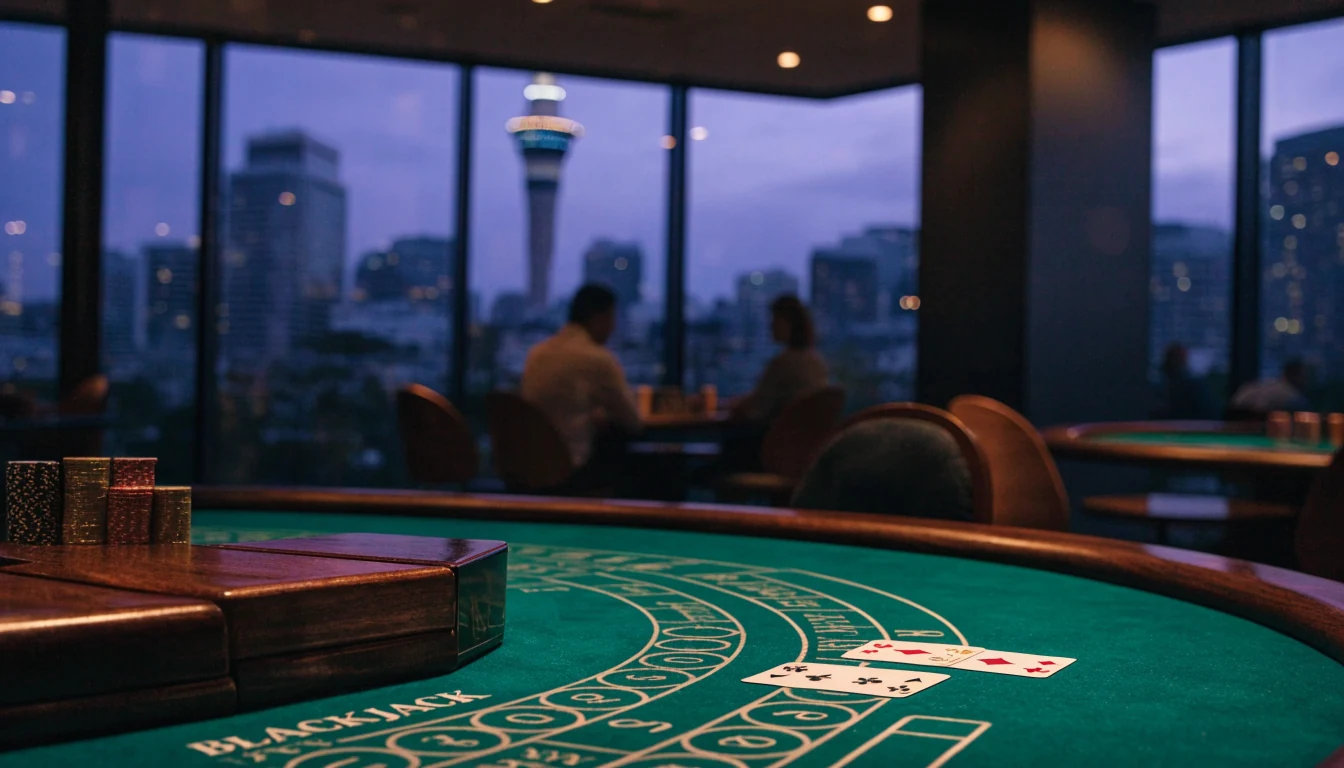
Practice hands can help make decisions more familiar, but they cannot establish that a strategy will produce a profit. Free practice may be used to rehearse choices such as hitting, standing, doubling down, splitting or surrendering where that option is offered. It can also help expose how a changed rule affects a decision. Results from a small run of hands, however, are not reliable evidence of long-term advantage.
Insurance is offered when the dealer’s visible card is an ace. It is a separate wager on whether the dealer has a natural blackjack, rather than a way to protect the player’s entire hand. For most players, insurance is generally not advisable as a routine bet. Its appeal can be misleading: a favourable-looking situation is not enough to show that the wager is beneficial, and the underlying odds depend on information about cards that are not visible.
Card counting based solely on mental calculation is not illegal under New Zealand law. That legal point does not establish that counting will work in a particular game or confer an advantage. In online play with automatic software shuffles, card counting cannot be assumed to provide useful information about future cards. Nor does practising a counting method guarantee a better outcome.
When practising online, the value lies in comparing decisions under stated rules, not in treating a winning streak as proof of a system. Strategy tools should be read as conditional guidance, with the table’s rules kept in view. If real-money play follows, a set budget and a decision not to chase losses help keep the activity bounded.
What “Unblocked” Free Blackjack Can—and Cannot—Establish
“Unblocked” is an access-related description, not a dependable statement about a game’s quality, terms or legal status. It may indicate that a page or game can be reached in a particular setting, but the word alone does not establish why access is possible or whether it will remain available. Access can depend on circumstances beyond the game itself, so a label cannot confirm that a title will load on every device or connection.
The phrase also does not identify what kind of blackjack is offered. A page described as unblocked might lead to a free-play game, but the label does not show whether play uses software or a live dealer, whether registration is required, or whether the game has cash value. Those details must be assessed separately from access. Nor does the term establish how the game works: rules, available decisions and payouts are determined by the specific table, not by whether its page is reachable.
Accessibility should not be treated as evidence of oversight or protection. A site being reachable does not, by itself, show that it is authorised under New Zealand’s regulatory framework, that its claims have been checked, or that a player would have domestic recourse. Conversely, difficulty loading a page does not by itself establish that the site is unlawful. Technical availability and legal status are distinct questions.
The word “free” also needs separate interpretation. It can describe play without a cash stake, but it does not prove that every feature is cost-free or that any displayed balance can be withdrawn. Any transition from casual play to real-money activity introduces separate terms and regulatory considerations; the access label does not resolve them.
Accordingly, “unblocked” is best understood as a limited description of access in some context. It cannot substantiate claims about safety, fairness, licensing, permanence, or a route around restrictions. Those conclusions require evidence specific to the service and the applicable rules. Treating the word as more than an access label risks confusing a page’s availability with what the game offers and the safeguards that apply.
Prepared by the Casino Experts NZ editorial staff.