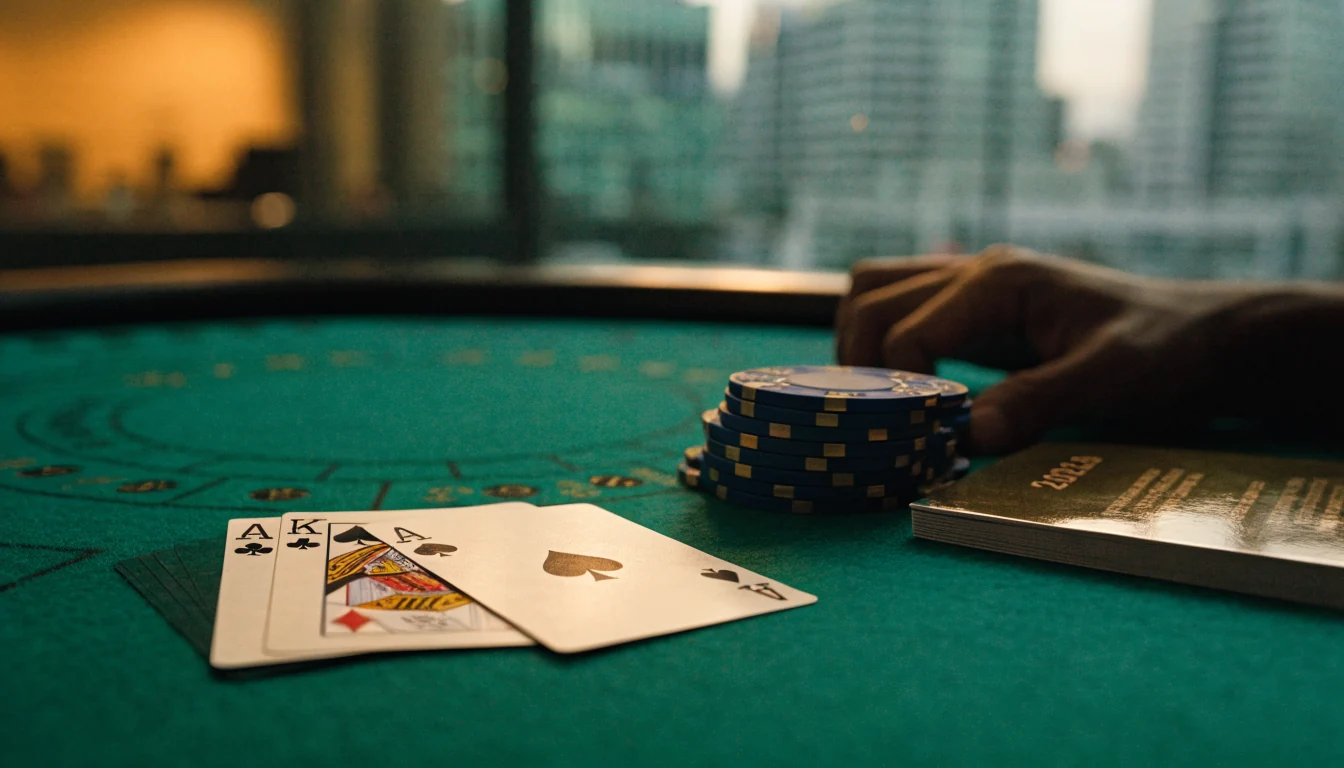
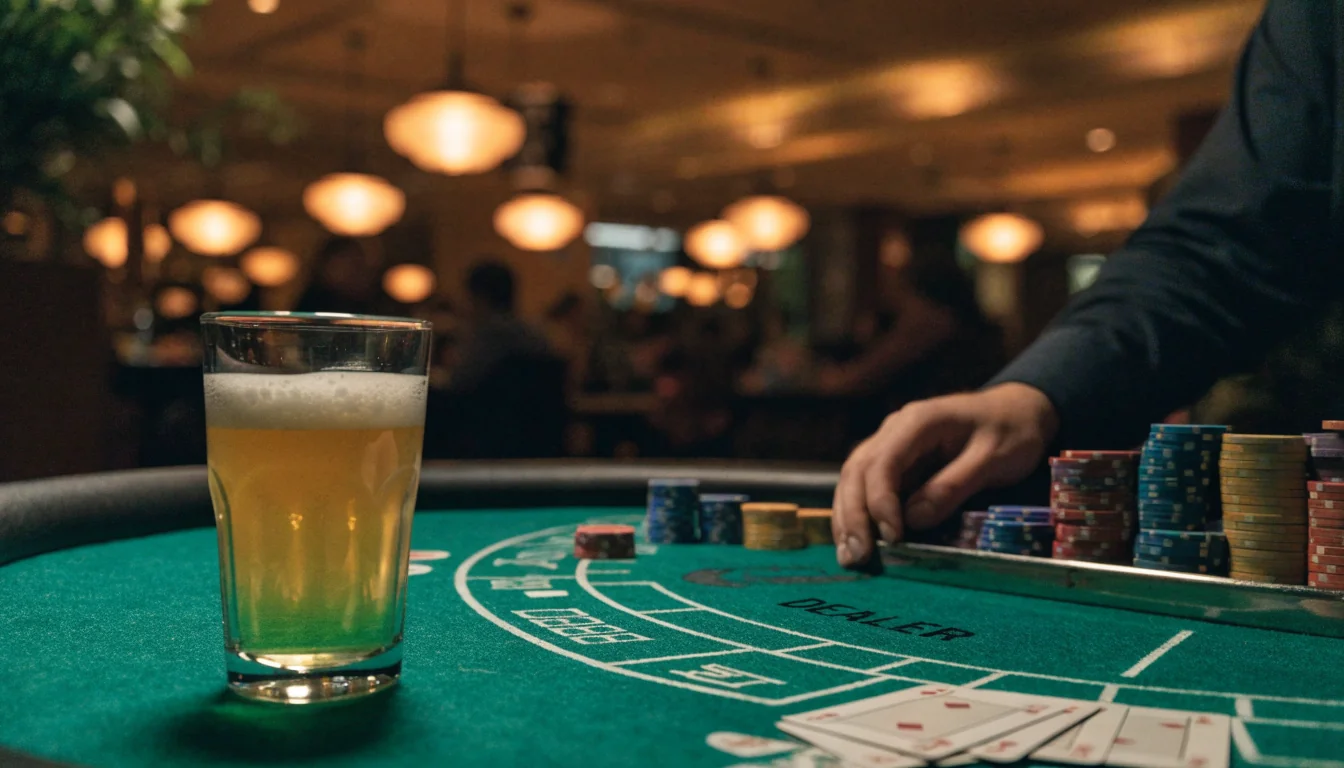
Live Blackjack in New Zealand: Rules and Play
 Available in US
A guide to live-table rules, payouts, free play, mobile sessions and the limits of strategy claims.

Table of Contents
- How Live Blackjack Tables Work
- New Zealand’s Online Casino Licensing Framework
- Live-Dealer Blackjack Compared with RNG Play
- What Free Play Can—and Cannot—Show
- Playing Live Blackjack Online: Rules Before the Session
- Using a Phone for Live Blackjack
- Bitcoin, Bonuses and Table Conditions
- Blackjack Payouts, Surrender and Insurance
- Assessing Live Blackjack Without a Guaranteed Strategy
- Card Counting in Live Online Blackjack
How Live Blackjack Tables Work
Blackjack is a contest between each player’s hand and the dealer’s hand. The aim is to finish closer to 21 than the dealer without going over. A hand that exceeds 21 is bust, so a higher total is not always better: the value depends on staying within the limit while comparing the final hands.
Number cards count at their printed value, while jacks, queens and kings count as 10. An ace can count as either 1 or 11, depending on which value makes the hand more useful without causing it to bust. A hand containing an ace may therefore change its effective total as further cards are dealt. For instance, if counting the ace as 11 would take the hand above 21, it can instead count as 1.
A round begins with players placing wagers and receiving cards. In a live blackjack game, a dealer handles actual cards at a physical table, while a camera feed shows the dealing. The game interface carries the player’s choices to the table and displays the hand as it develops. The dealer follows the table’s procedures, and each player’s result is assessed against the dealer’s hand rather than against other players at the table.
Choosing a live blackjack site in New Zealand calls for a clear look at the information available about each operator. Use these verdicts as a concise reference when deciding where to explore further.
License: Tobique Gaming Commission, licence no. 0000064 Neospin lists a licence from the Tobique Gaming Commission, licence no. 0000064.
License: Tobique Gaming Commission, licence no. 0000002 Ricky Casino lists a licence from the Tobique Gaming Commission, licence no. 0000002.
License: Curaçao Gaming Authority, licence no. OGL/2024/165/0185 BitStarz lists a Curaçao Gaming Authority licence, no. OGL/2024/165/0185.
License: Tobique Gaming Commission, licence no. 0000091 7Bit Casino lists a licence from the Tobique Gaming Commission, licence no. 0000091.
License: Malta Gaming Authority, licence no. MGA/B2C/370/2017 Play Grand lists a Malta Gaming Authority licence, no. MGA/B2C/370/2017.
Payout speed: 1-3 business days Wintino is listed with a payout speed of 1–3 business days.
Payout speed: 1-3 business days Lamabet is listed with a payout speed of 1–3 business days.
License: 07017519840 · Payout speed: 1-3 business days Zotabet lists licence number 07017519840 and a payout speed of 1–3 business days.
License: Malta Gaming Authority, licence no. MGA/B2C/394/2017 N1 Casino lists a Malta Gaming Authority licence, no. MGA/B2C/394/2017.
The choices during a hand
Once the initial cards are dealt, the available actions determine how a hand proceeds. Their names are shared across blackjack games, although the details attached to an action can depend on the game.
- Hit: Take another card. This can improve a low total, but it also increases the chance of exceeding 21.
- Stand: Take no further card and keep the current total. The hand then waits for the dealer’s result.
- Double down: Increase the wager under the game’s conditions and take a further card. This commits the hand to a particular next step, rather than allowing repeated hits.
- Split: Separate a pair into two hands and play each hand onward. The conditions for splitting are set by the table.
The options appear in the game interface when a decision is due. Selecting one does not change the card values or the objective; it determines what happens next to that hand. A player may be able to choose differently for separate hands after a split. The point of these actions is not to predict an outcome with certainty, but to decide how to proceed given the total and cards already visible.
After players have completed their decisions, the dealer plays the dealer’s hand according to the game’s procedures. The resulting totals are compared. A player who has gone over 21 has busted; a hand that remains in play is assessed against the dealer’s final total. The comparison is the core of the game: the player does not need to reach 21 if the dealer finishes with a lower total, but exceeding 21 ends the hand unsuccessfully.
What “live” means
A live-dealer table uses physical cards and a human dealer, with the dealing shown through a video stream. The online interface is still necessary: it presents the table, shows available actions, and records the player’s selections. The dealer does not simply appear as an animated figure generated by the game software; the cards are dealt at a real table and the stream provides a view of that process.

This differs from software-driven blackjack, where a program determines the cards using a random-number system rather than showing a dealer handling physical cards. Both formats present a blackjack hand for play, but the live format combines a streamed table with digital controls. The stream is the visual record of the dealing; the interface is the means by which a remote player participates.
For a person looking for a live blackjack table online, the word “live” therefore refers to the dealer and cards being real, not to a different objective or a separate set of card values. The familiar choices—hit, stand, double down and split—remain the basis of play where the table offers them. A live casino blackjack experience can still differ from another table in its specific conditions, so the format alone does not establish every rule that applies to a hand.
The same distinction matters when considering a single hand. Its outcome follows from the cards dealt and the decisions made under that table’s conditions; seeing the dealer in real time does not make the result predictable. Nor does the presence of a live host turn the game into a contest against the other people shown at the table. Each player’s hand is measured against the dealer.
Terms such as “tricks” can suggest that a simple action reliably changes the result. The basic mechanics do not support that implication: the cards determine the hand’s total, and the available actions shape how it is played. Understanding those mechanics clarifies what happens at a live table without implying that any choice guarantees a particular outcome.
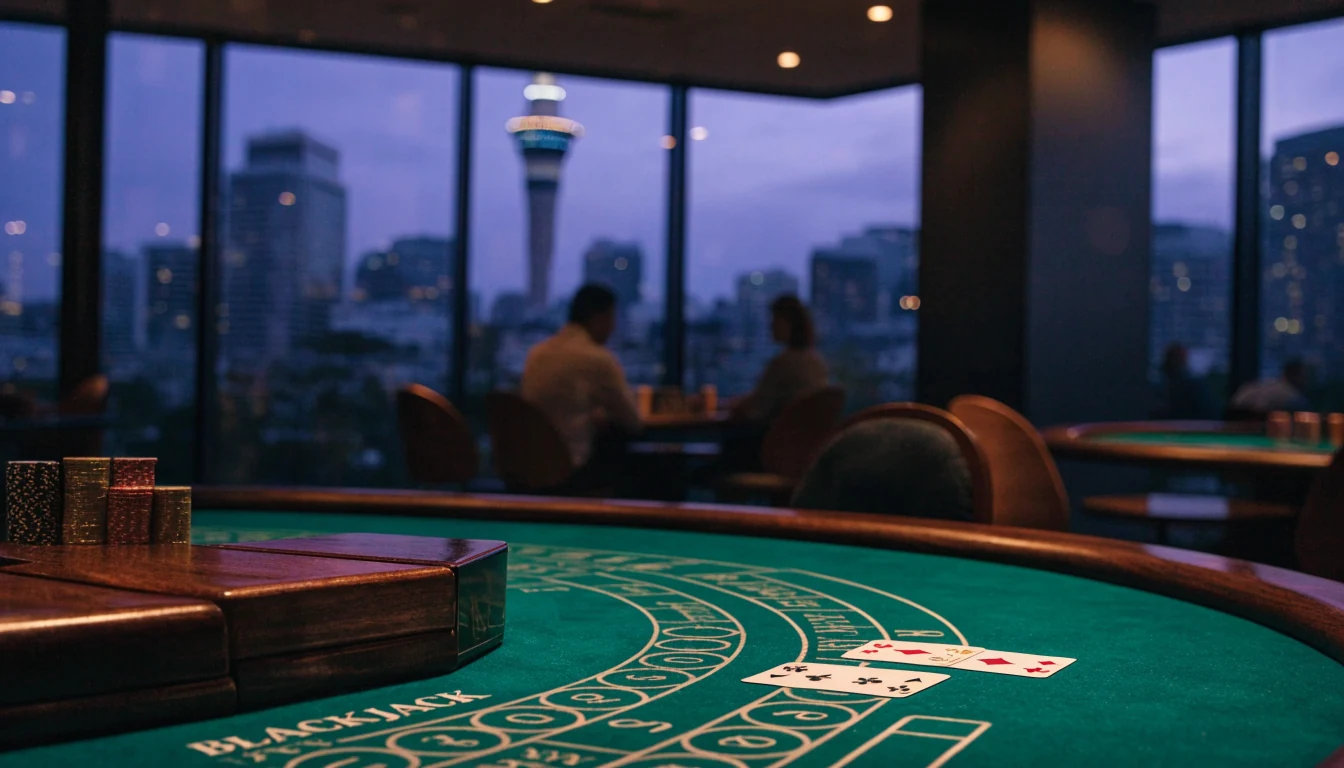
New Zealand’s Online Casino Licensing Framework
The regulation of online casino gambling in New Zealand is moving from an environment without domestic licensing to a statutory licensing system. This distinction matters when interpreting claims about live blackjack in New Zealand in 2026: the existence of a licensing framework does not mean that every online casino is already licensed under it, or that the full regime is operating.
The Department of Internal Affairs (DIA) is the primary gambling regulator and oversees the online casino licensing framework. The Gambling Commission has a separate decision-making role. It considers casino licence applications and determines them; it also issues online casino licences and decides whether proposed changes to licence conditions can be approved. The framework therefore places general regulatory oversight with the DIA while assigning licensing decisions to the Commission. These functions are related, but they are not interchangeable.
A transition from the earlier position
Before the Online Casino Gambling Act 2026, New Zealand law did not permit online casinos to be based domestically. The Gambling Act 2003 prohibited domestic online casinos, while online casino services supplied from outside the country were not licensed or supervised by a New Zealand regulator. A person who wagered with an offshore website during that period had no domestic government recourse through an online casino licensing system.

The Online Casino Gambling Act 2026, which came into force on 1 May 2026, established New Zealand’s first domestic licensing regime for online casino gaming. It provides the legal framework for regulating this activity, but its commencement did not immediately make the complete licensing system operational. The Act instead sets out a transitional period running from 1 May 2026 to 1 December 2026. During that interval, online casinos that were already providing services to people in New Zealand before the Act came into force may continue operating, subject to the Act’s transitional provisions.
That qualification is important. Transitional permission is not the same thing as a licence issued under the new regime. The status of a provider during the transition must be understood in relation to when it was operating and the provisions that apply to it. The full licensed system is not expected to be fully operational until 2027. Accordingly, references to a licensed live blackjack casino in 2026 require attention to the stage of the transition and the provider’s actual regulatory status; the general creation of a licensing framework cannot, by itself, establish that a particular service holds a New Zealand licence.
Division of responsibilities
The DIA’s oversight role sits within its broader position as New Zealand’s primary gambling regulator. The Gambling Commission, by contrast, handles the adjudication of casino licensing applications and the issuing of licences. Its authority also extends to approving changes to licence conditions. In practical terms, the Commission’s decisions determine whether an application is granted and whether specified licence conditions may be altered, while the DIA oversees regulation of the framework.
Regulatory Roles
The Department of Internal Affairs (DIA) provides general regulatory oversight, while the Gambling Commission handles the adjudication of licence applications and the issuing of licences.
This division gives the two bodies distinct responsibilities rather than making them duplicate licensing authorities. A description that attributes all licensing decisions to the DIA would overlook the Commission’s stated function. Conversely, describing the Commission as the sole gambling regulator would omit the DIA’s primary regulatory and oversight role. The statutory arrangement is best understood through the separate functions assigned to each institution.
The framework also sets limits on providers’ ability to continue operating through the transition. Providers that were already serving New Zealand customers before 1 May 2026 may continue until 1 December 2026 under the transitional provisions. Providers that have not applied for a licence must cease online casino gambling in New Zealand by that date. If an application is declined, the provider must stop all online casino gambling operations in the country and leave the market. Unlicensed operation is expected to become an offence around mid-2027, and operators without a licence may face enforcement action and fines of up to NZ$5 million.
What the framework does—and does not—establish
The licensing regime is a change in the regulatory position, not a guarantee about an individual table, game or service. It identifies the bodies responsible for oversight and licensing decisions and provides a route for online casino providers to seek authorisation. It does not establish, without further evidence, that a particular live blackjack service has been licensed, that its table conditions are uniform, or that its operation is appropriate for every player.
The transition also has a specific restriction on promotion: online casino gambling must not be advertised to people in New Zealand during this period. After licensing, advertising by licensed operators is permitted only under tight rules, and sponsorships are prohibited. These restrictions concern promotion and do not alter the Commission’s licensing role or the DIA’s oversight responsibility.

For live blackjack online, the relevant legal context in 2026 is therefore transitional. New Zealand has established a domestic licensing framework, but the full licensed regime is expected to follow in 2027. The distinction between historical offshore provision, transitional operation and licensing under the new system is necessary for any accurate account of the market.
Live-Dealer Blackjack Compared with RNG Play
The main distinction between live-dealer blackjack and RNG blackjack is how each game produces its cards. A live table uses actual cards handled by a dealer and shown through a video stream. An RNG game uses software shuffles, with the results presented on screen rather than filmed from a physical table. Both are digital ways to play, but they offer different forms of interaction and different pacing.
A live stream makes the dealer and cards visible, giving the session a closer resemblance to a casino table. Decisions and card handling take place in a shared, observable setting, rather than being represented solely through the game interface. That difference is about presentation and process: seeing physical cards does not, by itself, establish that a player will get a particular result or that one format is more favourable.
RNG play is generally faster because software can move from one hand to the next without the visible handling and dealing involved in a live broadcast. This can suit play where quick rounds and a direct interface matter more than watching a dealer. The pace is not simply a cosmetic difference: a faster game can mean that decisions occur in a more compressed sequence, while live play builds in pauses associated with the streamed table.
Uses a video stream of a physical table and actual cards, offering a closer resemblance to a casino but with potential stream delay.
Uses software-driven shuffles for faster gameplay and a more direct interface without dependence on a video feed.
Those pauses are part of the live format, but streaming can also introduce delay. The image and game activity may not appear instantaneously, which can make the experience feel less immediate than a software-driven game. A delay does not change the fact that actual cards are being used, but it can affect how smoothly the session is followed. RNG blackjack avoids dependence on a live video feed and therefore does not involve the same kind of stream delay.
The trade-off is not simply “real” against “virtual.” Live blackjack is real in the sense that physical cards are dealt, while the online experience still depends on a video connection and the interface used to participate. RNG blackjack does not show a physical deal, but it provides a more direct software-based sequence. Which distinction matters more depends on whether visible dealing or speed is the more relevant feature of the experience.
Betting conditions can also differ in practical importance. Live-dealer games may require higher bets than RNG games, so the two formats should not be treated as interchangeable on that point. The presence of a dealer and a streamed table does not automatically make a live game suitable for every player or every budget. Nor does faster software play establish that an RNG table is preferable: speed describes the pace, not the quality of an outcome.
For someone comparing live blackjack in New Zealand, the format label alone is therefore insufficient to describe the session. The relevant contrast is between a physical deal shown by stream, with possible delay and potentially higher betting requirements, and a software-shuffled game that can proceed more quickly. These are observable differences in how play is delivered. They do not establish a general advantage for either format, and neither presentation provides a basis for predicting the result of a hand.
The choice between the formats is best understood as a preference about process rather than a prediction about returns. A streamed dealer offers visible physical cards and a more table-like setting; RNG play offers software dealing and a quicker rhythm. The distinction can clarify what a game involves, but it cannot remove the uncertainty inherent in blackjack.
What Free Play Can—and Cannot—Show
Free-play mode can provide a setting for becoming familiar with blackjack decisions without staking real money. It may help clarify how the interface records a hit, stand, double down or split, and how a sequence of choices is entered. That is a limited but practical form of rehearsal: it concerns the mechanics of placing decisions, not whether those decisions will produce a particular result when money is involved.
A simulated session is not evidence that a table will be profitable. A favourable run in free play does not establish that the same outcome will recur, nor does an unfavourable run predict losses in later real-money play. Individual results vary, and a short session cannot establish the long-run performance of a game or a decision pattern. Free play should therefore be treated as practice, not as a test of a reliable way to win.
The label alone also does not establish how closely a free version reflects a real-money table. The available rules and game settings can differ between blackjack variants, and those differences may affect both strategy and house edge. Familiarity with one version should not be taken as evidence that another table has identical conditions. The rules displayed for the particular game are more relevant than the fact that it offers a free mode.
Attention: A favourable run in free-play mode is not evidence that a table will be profitable in real-money play, as individual results vary.
Free play may help identify interface details that are easy to overlook while learning, such as where the available actions appear or how the game presents a decision. It cannot show that a player will respond in the same way under real-money conditions. The absence of a financial stake changes the context of play, so practice decisions should not be treated as a dependable forecast of decisions made during a paid session.
For anyone considering a move from practice to real-money play, the distinction matters. A demonstration can familiarise a player with the basic controls, but it cannot establish that a specific table will deliver a particular result or that a practice approach will remain effective. Before playing for money, the table’s rules and any relevant terms should be checked on trustworthy sites and casino pages. Blackjack can also contribute differently to wagering requirements, and maximum-bet rules may apply while those requirements are being met; bonus conditions should therefore be read rather than inferred from a free-play experience.
A free session is not a substitute for setting a budget before real-money play. Any spending limit should be treated as fixed, and losses should not be chased by increasing stakes or extending a session. If the purpose is only to learn the actions, free play can serve that narrow purpose without being confused with evidence about future returns. The distinction is especially important where a game’s rules or interface differ from the version used for practice.
Playing Live Blackjack Online: Rules Before the Session
A live table’s rules are part of the game, not a minor detail to review after play has begun. Tables can use different rule sets even when they share a familiar blackjack format. Before joining, the table information or rules panel should be checked for the conditions that determine how hands are dealt and which choices are permitted.
The number of decks is one point to verify. Rules can also specify whether the dealer hits or stands on soft 17, how surrender is handled, and what a natural blackjack pays. These details vary between games; a specialist review also reports such variation, but the terms of an individual table are the relevant guide for a session. A title or image alone cannot establish the rules in force.
Check the rules attached to the table
The rules panel should be treated as the reference for the selected game, rather than relying on a general description of blackjack or assumptions drawn from another table. If the information is unclear, incomplete, or difficult to locate, the terms should not be inferred from the game’s name. A small difference in wording may determine whether a particular action is available or how a hand is resolved.
The table’s listed variant matters as well. Blackjack variants differ in their rules, and those differences can affect both strategy and the house edge. A strategy considered in one format may not carry over unchanged to another. The presence of familiar actions or a live dealer does not, by itself, show that two tables apply identical conditions.
Payout wording deserves particular attention. A specialist review reports that natural-blackjack payouts can differ between tables, including 3:2 and 6:5. That should not be treated as a market-wide rule or as evidence of the payout at any specific table. The displayed terms for the chosen game need to state the applicable payment clearly.
Table Rule Verification
- Check the number of decks used
- Verify if the dealer hits or stands on soft 17
- Confirm if surrender is available
- Check the payout rate for a natural blackjack
Compare conditions, not labels
When comparing tables, a consistent checklist makes differences easier to identify: deck count, the dealer’s soft-17 rule, surrender availability, and the stated blackjack payout. The same variant name may not answer every question, so the detailed rules remain more informative than a broad label such as “classic” or “standard.” If a table does not state a condition, it is safer to regard that point as unresolved than to assume it matches another game.
This is also a more defensible way to interpret claims about the best live blackjack online. “Best” cannot be determined from a table name alone: the relevant comparison is between the documented conditions and the player’s understanding of them. A favourable-sounding label does not establish a lower house edge, and a rule difference does not by itself show how a particular session will turn out.
Reading the rules before play does not predict results. It clarifies the framework under which decisions are made and helps prevent a table from being mistaken for a different variant. For anyone intending to play live blackjack online, the table-specific terms—not assumptions based on another game—are the soundest basis for understanding the session.
Using a Phone for Live Blackjack
On a phone, live blackjack combines a streamed table with a digital interface for placing bets and selecting actions. The cards are real, dealt at a casino table and shown through a camera feed. A phone screen therefore presents a live game, rather than a graphical recreation of cards generated by software.
The stream adds a practical dependency that does not arise in the same way in software-driven play: the video and game interface must remain sufficiently synchronised. Streaming can delay the action, making the transition between a dealer’s move and the next betting opportunity feel slower. A delay is a feature of the connection and presentation, not evidence that the cards are being dealt by software. It can also make a live table less suited to someone seeking a rapid sequence of hands.
A small screen can affect how clearly the table, cards and controls appear. The interface needs to make the current hand and available actions legible without requiring constant switching between views. If the stream occupies most of the display, controls may be less prominent; if the interface prioritises controls, details of the table may be harder to see. These are practical considerations rather than differences in the underlying blackjack objective.
The distinction matters when choosing between a live table and a phone-based game that uses software. In live play, the phone carries a video feed of actual cards and a mechanism for interacting with the table. In software-driven play, the game is presented directly by the device without that live-dealer stream. The latter can proceed faster because it does not depend on streamed footage and dealer activity. A phone does not, by itself, determine which format is being played.
Live-dealer tables may also require higher bets than software games. That can make the format less suitable where the available table conditions do not fit a planned budget. The minimum permitted bet is therefore a material point to inspect before play, alongside whether the interface displays the stream and betting controls clearly. A polished mobile layout cannot offset a table whose required stakes are unsuitable.
- Check if the game is genuinely streamed
- Ensure the interface is readable on your device
- Verify that betting conditions fit your budget
- Assume a polished layout offsets unsuitable stakes
- Expect the same speed as software-driven games
- Chase losses by increasing stakes
There is no sound basis for treating one phone app as universally best for live blackjack. The relevant assessment depends on observable features: whether the game is genuinely streamed, whether the interface remains readable on the device, whether delays disrupt play, and whether the table’s betting conditions are manageable. For real-money play, a budget should be set in advance and losses should not be chased.
Bitcoin, Bonuses and Table Conditions
A search for live blackjack funded with bitcoin can combine two separate questions: whether a site accepts that payment method and what conditions apply at its blackjack tables. One does not establish the other. Payment options can vary between operators, and a game’s rules are a separate matter; the availability of bitcoin should therefore be confirmed in the operator’s current payment information rather than assumed from a game description.
A bonus attached to casino play also does not, by itself, establish that live blackjack qualifies on the same terms as other games. The offer’s wording should be checked for eligible games, any contribution blackjack makes towards wagering requirements, and maximum bet rules that apply while wagering requirements are being met. Those conditions can affect how a promotion works in practice. The headline value of an offer is not enough to determine whether blackjack play counts or what restrictions apply.
Table conditions remain relevant whether play is funded with bitcoin, another payment method, or bonus funds. A specialist review reports that blackjack tables can differ in deck count, the dealer’s action on soft 17, surrender availability and payout rules. These differences should not be treated as uniform across live games. The information for the particular table is more relevant than a general description of blackjack or a promotion.
The distinction matters because bonus terms and table rules answer different questions. Promotion conditions govern whether play qualifies and what restrictions apply during wagering. Table rules govern how the game is dealt and settled. A bonus does not change a table’s stated rules, and a payment method does not establish that a promotion is available.
Before real-money play, the relevant payment details, full bonus terms and table rules should be checked together on trustworthy sites and casino pages. If the terms do not clearly explain blackjack eligibility, contribution to wagering requirements, or applicable maximum bets, the promotion’s practical effect cannot be established from its headline. Budget limits should be set in advance, and losses should not be chased.
Blackjack Payouts, Surrender and Insurance
A payout depends on the table’s rules, so a live game’s displayed conditions matter as much as its format. A specialist review reports that a natural blackjack may pay at a 3:2 rate, while some tables offer 6:5. This is a reported contrast, not evidence that either payout applies across New Zealand tables. The payout shown in the game rules determines what a natural blackjack returns, and a lower rate changes the return on that hand.
In live blackjack, the dealer handles actual cards while players make decisions through the game interface. The objective remains to finish closer to 21 than the dealer without going over. A player may hit, stand, double down or split, subject to the table’s rules. These actions affect how a hand proceeds; they do not alter the payout terms set for the game.
Insurance Risk
Insurance is a side wager that is generally not recommended for most players as it is not a routine way to improve a hand’s prospects.
Surrender is another possible action, but it is not available under every set of table rules. Where offered, it allows a player to give up a hand under the conditions specified by that table. The timing and availability of surrender should therefore be checked in the rules rather than assumed from the presence of a live dealer. Rules can differ between games, including rules that affect the choices available during a hand.
Insurance should be treated separately from the main hand, not as a routine way to improve its prospects. It is a side wager whose presence does not establish that it is favourable. For most players, avoiding insurance is the cautious approach; the available information does not support presenting it as a recommended bet.
Before a real-money session, the table’s payout and action rules should be read alongside the relevant terms on a trustworthy site or casino. A familiar game name does not guarantee identical conditions from one table to another. A budget set in advance can help keep play within intended limits, and losses should not be chased by increasing stakes.
Assessing Live Blackjack Without a Guaranteed Strategy
The idea of the “best” live blackjack game is more useful when treated as a comparison of stated conditions than as a promise of better results. No table selection can guarantee a winning session. Blackjack variants differ in ways that can affect both decisions and the house edge, so a title or general description is not enough to establish how a particular game compares.
A practical assessment begins with the rules displayed for the table. The number of decks, the dealer’s action on soft 17, surrender availability and the payout for a natural blackjack are among the conditions that may differ. These details should be read together: a favourable feature in one area does not, by itself, show that the full set of rules is favourable. The relevant comparison is between complete rule sets, not isolated claims.
Descriptions in a specialist review can help identify conditions worth checking, but the table’s own rules are more directly relevant to the game being considered. Where descriptions conflict or omit a condition, the comparison remains uncertain. A label such as “best” cannot resolve that uncertainty, nor does it establish that one game will produce a better outcome for an individual session.
A sound evaluation therefore separates verifiable terms from predictions. Rule differences can be documented and compared; future results cannot be inferred from them with certainty. This is distinct from card counting, which concerns tracking the composition of cards already dealt and has separate limits in online play. Neither a favourable rule set nor a proposed system turns blackjack into a guaranteed source of profit.
Card Counting in Live Online Blackjack
Card counting is a method of keeping track of cards that have appeared and using that information to assess the remaining composition of a deck. In New Zealand, counting cards through mental calculation alone is not illegal. That legal point does not establish that the method is effective at an online table, or that it will produce a favourable result.
The distinction between live-dealer and RNG blackjack matters. A live-dealer game uses actual cards, while an RNG game relies on software shuffles. RNG blackjack also allows faster play, so the sequence of hands is generated and dealt differently from a physical table. Where software shuffles are automatic, claims that card counting can reliably identify a profitable opportunity should be treated cautiously; there is no basis for presenting it as a guaranteed system.
The presence of a live video stream also does not, by itself, show that a player can use card counting successfully. The legal status of mental calculation and its practical value are separate questions. A method may be lawful without being effective in a particular online format, and legality should not be confused with an advantage over the game.
Card counting is not a substitute for understanding the conditions of a table, nor does it remove the uncertainty inherent in blackjack. Results can vary, and no approach can ensure a win. A considered approach therefore avoids treating a sequence of observed cards as a promise of future returns. Setting a budget and not chasing losses remain important safeguards, whether play involves a live dealer or software-driven blackjack.
What is card counting?
Card counting is using mental calculation to keep track of cards in blackjack.
Is card counting illegal?
No. Card counting using only mental calculation is not illegal under New Zealand law.
Does blackjack always pay 3:2?
No. A natural blackjack often pays 3:2, but some tables pay 6:5.
Written by the editors at Casino Experts NZ.