French Roulette in New Zealand: Rules and Odds
 Available in US
Explore the French wheel, its table layout and rules such as La Partage and En Prison, alongside odds and comparisons with American roulette.

Table of Contents
- Free French Roulette Online: What the Odds Still Mean
- French Roulette Online in New Zealand: Regulation and Access
- The French Roulette Wheel and Live Table Layout
- How French Roulette Bets Work: La Partage and En Prison
- French Roulette Probability and the Limits of Strategy
- French Roulette vs American Roulette: The Wheel and the Edge
- French Roulette Payouts and Playing for Fun
- French Roulette Call Bets and Wheel-Based Neighbours
- French Roulette Casinos and the Blackjack Edge Comparison
- French Roulette Gold Live: What the Available Evidence Can Establish
Free French Roulette Online: What the Odds Still Mean
Free French Roulette offers a way to engage with the game without placing a real-money stake. That distinction matters for the experience: a result in free play does not itself transfer money to or from a player. It does not, however, alter the underlying process that produces roulette outcomes. A simulated spin is not evidence that the next spin in a later session will be more likely to land on a particular result.
The phrase “French Roulette” names a roulette variant; it does not mean that the game is necessarily being played in French. Roulette is a French-derived word associated with a small wheel, while the game name refers to a particular form of roulette. The language of a game interface and the rules represented by its title are separate matters. A free online French Roulette game may therefore be encountered as a French-themed or French-rules title without the word “French” establishing the interface language or the terms of a specific game.
French roulette players in New Zealand can use this guide to review the available operator information before choosing where to play. Check the details that matter to you and confirm the terms directly with the operator.
License: Tobique Gaming Commission, licence no. 0000064 Neospin lists a licence from the Tobique Gaming Commission, number 0000064.
License: Tobique Gaming Commission, licence no. 0000002 Ricky Casino lists a licence from the Tobique Gaming Commission, number 0000002.
License: Curaçao Gaming Authority, licence no. OGL/2024/165/0185 BitStarz lists a Curaçao Gaming Authority licence, number OGL/2024/165/0185.
License: Tobique Gaming Commission, licence no. 0000091 7Bit Casino lists a licence from the Tobique Gaming Commission, number 0000091.
License: Malta Gaming Authority, licence no. MGA/B2C/370/2017 Play Grand lists a Malta Gaming Authority licence, number MGA/B2C/370/2017.
Payout speed: 1-3 business days Wintino states a payout speed of 1–3 business days.
Payout speed: 1-3 business days Lamabet states a payout speed of 1–3 business days.
License: 07017519840 · Payout speed: 1-3 business days Zotabet lists licence number 07017519840 and states a payout speed of 1–3 business days.
License: Malta Gaming Authority, licence no. MGA/B2C/394/2017 N1 Casino lists a Malta Gaming Authority licence, number MGA/B2C/394/2017.
Free play can be useful for learning how a game is presented and for becoming familiar with its pace. It can also let someone explore an interface without committing a stake. Those practical uses should be kept distinct from claims about prediction or advantage. Playing without money changes the consequences of an individual result for the player; it does not make the outcome of that result informative about what must happen next.
Roulette spins are independent. The result of an earlier spin does not alter the probability of outcomes on a later spin. A sequence that appears repetitive, unusual or balanced does not create a rule that the wheel must follow in response. In free French Roulette, a run of one colour, a gap between particular results or a recent cluster of outcomes may be visible in a history display, but none of those observations makes the next result due. A record of past spins describes what has already happened; it does not determine the future.
This point applies whether play is free or involves money. Free mode does not create a special predictive pattern, and moving from free play to real-money play does not carry forward an advantage earned in the earlier session. Nor does repeated practice turn random outcomes into a sequence that can be forecast from the results alone. Familiarity with the interface may reduce uncertainty about where controls are or how information is displayed, but that is different from knowing what a future spin will produce.
The term “free” can also refer to different experiences, so it is worth distinguishing them conceptually. A no-stake mode means that the player is not risking money on the recorded result. A promotion or bonus, by contrast, may involve conditions attached to later play. Those are not interchangeable descriptions: a free-play session should not be assumed to have the same terms as a promotion, and a promotional balance should not be treated as equivalent to risk-free play. The relevant conditions depend on the specific offer and game.
For readers looking for free online French Roulette, the most reliable expectation is modest: it can provide a low-consequence way to observe a game, but it cannot demonstrate that a betting pattern predicts outcomes. The same applies to searches that combine “free” with “French Roulette” in different word orders or languages. Those variations describe an interest in trying the game without a stake; they do not imply a different mathematical process.
The difference between free and real-money play is therefore about financial exposure, not the independence of spins. Free play removes the immediate financial consequence of a simulated result. Real-money play introduces the possibility of losing the amount staked, while leaving the random nature of roulette unchanged. Every real-money bet can lose, and no sequence from a free session can guarantee a result. Anyone choosing to play for money should not risk more than they can afford to lose.
Free play can serve as an introduction, but its limits should remain clear. It may show how a particular game is arranged and how a session proceeds. It cannot establish a reliable forecast from past spins, and it cannot make a future result more predictable. The central distinction is simple: the stake may be absent, but the independence of roulette outcomes remains.
Responsible Gambling
Anyone choosing to play for money should not risk more than they can afford to lose, as every real-money bet can lose.
French Roulette Online in New Zealand: Regulation and Access
The legal position for online casino gambling in New Zealand changed with the Online Casino Gambling Act 2026, which came into force on 1 May 2026. The Act establishes the country’s first domestic licensing system for online casino gaming. It does not mean that every website offering French Roulette is locally licensed, or that a full licensing regime was operating from the day the law took effect.
The Gambling Act 2003 had prohibited online casinos from being based in New Zealand. Before the new Act, gambling sites operating from overseas were not licensed or supervised by a New Zealand regulator. Customers using those services had no domestic government recourse in a dispute. Offshore sites have been practically accessible to New Zealand residents, and the legal framework does not impose a fine or criminal prosecution on a player simply for wagering with one.
Transition to licensing
The 2026 Act created a transition running from 1 May to 1 December 2026. During that period, only providers that were already serving people in New Zealand before the Act commenced may continue, and then only under the Act’s transitional provisions. A provider that has not applied for a licence must cease conducting online casino gambling in New Zealand by 1 December 2026.
The transition is not permission for new providers to enter the market, nor does it make an existing service equivalent to a fully licensed operator. The full licensed regime is not expected to be operational until 2027. Unlicensed operation is expected to become an offence around mid-2027, and operators without a licence may face enforcement action and fines of up to NZ$5 million. These consequences concern providers, not players.

Advertising is also restricted during the transition: online casino gambling services must not be advertised to people in New Zealand. This applies to promotion directed at the local public, including advertising framed around a particular game such as French Roulette. The distinction matters because a website being accessible does not establish that it is authorised under the new domestic system, and access should not be confused with an invitation to use or promote a service.
Regulatory responsibilities
The Department of Internal Affairs is New Zealand’s primary gambling regulator and oversees the online casino licensing framework. The Gambling Commission has a separate licensing role: it hears and determines casino licence applications, issues online casino licences, and approves changes to licence conditions. These responsibilities place policy oversight and licensing decisions within the domestic framework rather than leaving online casino regulation solely to the jurisdiction where a website is based.
The Act also requires licensed operators to use stricter age and identity verification systems. These checks are part of the licensing regime, rather than a feature that can be assumed for every site available from New Zealand. During the transition, the difference between a provider allowed to continue temporarily and one holding a licence is therefore material. A site’s presentation of French Roulette, or its use of New Zealand currency or language, does not by itself demonstrate that it has a New Zealand licence.
For someone considering online French Roulette in New Zealand in 2026, the relevant distinction is between temporary operation under transitional provisions and operation under the future licensing system. The regulatory status depends on the provider’s position under the Act, not on the roulette variant it offers. The law establishes a route to domestic oversight, while the transition preserves limited continuity for qualifying existing providers until the specified end date.
Licensing Transition
From 1 May to 1 December 2026, only providers already serving New Zealand may continue under transitional provisions, with a full licensed regime expected in 2027.
The French Roulette Wheel and Live Table Layout
French Roulette is identified by its wheel, not by a unique physical shape of table. Its wheel has a single-zero arrangement shared with European Roulette. The French name therefore does not indicate a different sequence of pockets from the European wheel. What distinguishes the French version is the presence of rules such as La Partage and En Prison, rather than a separate wheel design.
A live game presents two related but distinct views: the wheel and the betting layout. The wheel is the circular mechanism, with numbered pockets around its rim and a central spindle. The table layout is the flat surface, or its digital representation, where betting positions are shown. In a streamed game, both may appear in the same frame, but the camera view of the wheel should not be mistaken for the layout used to organise wagers.
On the table, the numbers are arranged in a rectangular grid, with additional marked areas around it. This grid is not a map of the wheel’s order. Numbers that sit next to each other on the felt are not necessarily neighbours around the wheel. That distinction is particularly important when a live interface shows the wheel and betting area side by side: they represent separate arrangements serving different purposes.
The surface may be presented as a traditional green table in a studio, or as a rendered layout on screen. In either case, a French Roulette layout can be recognised by the single-zero wheel and the French table presentation, although the precise visual design may differ between operators and games. Labels, colours, chip controls and camera framing are interface choices, not evidence that the underlying wheel has changed.
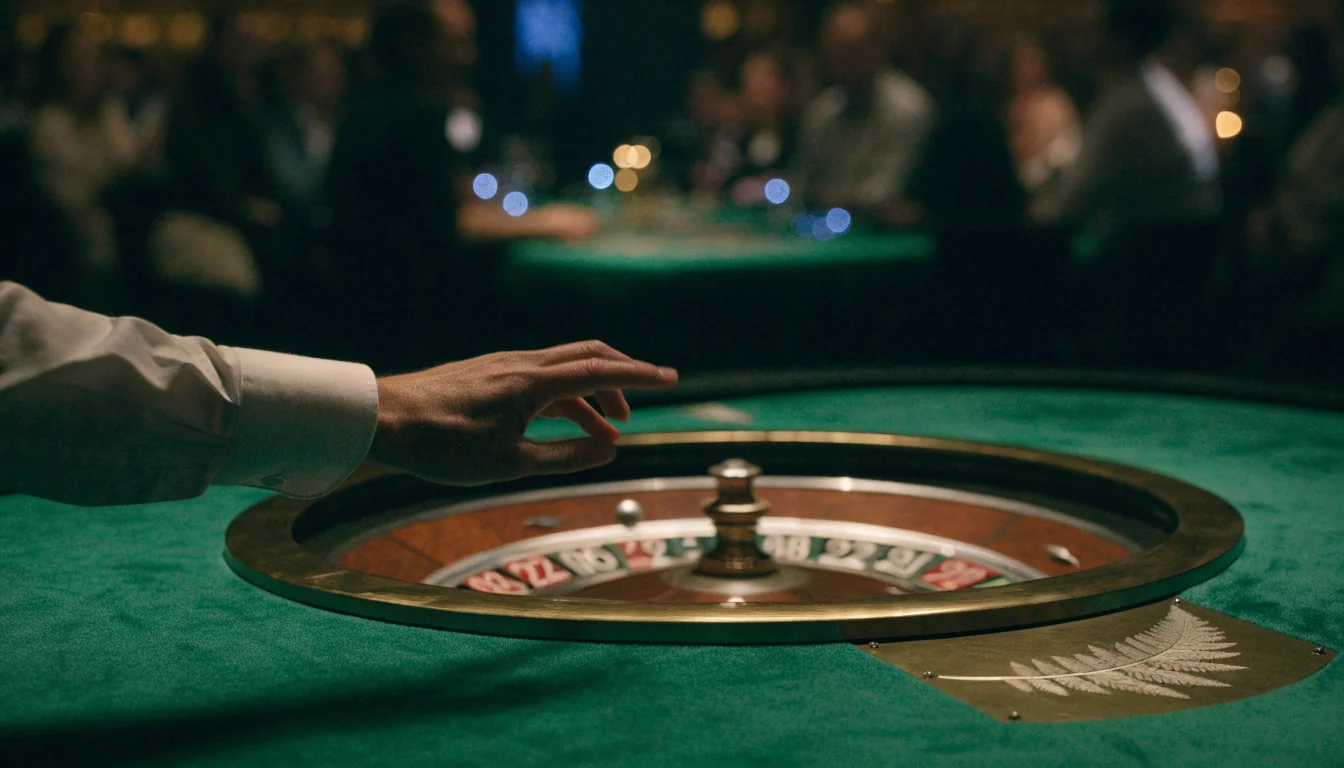
In a live French game, a dealer operates the physical wheel and the camera shows the table activity. The screen may provide a close view of the wheel, a wider view of the table, or both. Digital controls generally let a participant select a position on the represented layout, while the streamed table supplies the visual context for the spin. These functions do not make the physical wheel and the on-screen grid interchangeable: the wheel determines the sequence of pockets, while the table displays where selections can be placed.
Automatic roulette is a different presentation from a dealer-led live table. A live auto game may show a physical wheel without a human dealer handling each round, while the interface still presents a betting layout on screen. The exact production and interface depend on the game. The word “live” describes the relationship to a real-time wheel or streamed setting; it does not, by itself, specify whether a dealer is visible or how the game is operated.
A French Roulette online game can also be displayed without a live video feed. A desktop browser and a mobile screen may arrange the same basic wheel and table elements differently, with controls repositioned to fit the available display. “French Roulette not desktop” is therefore better understood as a question about access on a non-desktop device than as a different roulette format. The screen size can change how the layout is shown, but does not establish a different pocket arrangement.
- Check if the wheel is single-zero
- Verify if the betting surface is identified as French Roulette
- Assume the table layout map matches the wheel order
- Mistake interface choices for changes in the underlying wheel
Demo versions may reproduce the visual layout and controls of a paid game, though a demonstration interface alone does not show that every live-table feature is present. For comparing formats, the key visual check is whether the wheel is single-zero and whether the displayed betting surface is identified as French Roulette. The table’s appearance can vary; the shared wheel structure is the more stable point of comparison.
How French Roulette Bets Work: La Partage and En Prison
The special French rules concern what happens to certain bets when the ball lands on zero. They do not apply to every wager on the layout: eligibility is limited to even-money outside bets. These include red or black, odd or even, and low or high. A straight-up number bet, for instance, is not covered by La Partage or En Prison.
At a table, the relevant condition is therefore the combination of bet type and result. If zero does not land, these rules do not alter the ordinary settlement of an eligible even-money bet. If zero does land, the table’s stated rule determines what happens to the stake. French tables may use La Partage or En Prison; the terms describe different outcomes, not two names for the same settlement.
La Partage: half the stake is returned
With La Partage, an eligible even-money bet is divided in effect when zero appears. Half of the original stake is returned, while the other half is collected by the casino. The bet is not treated as a win, and the player does not receive an even-money profit. The immediate result is a partial loss rather than losing the entire stake.
For example, a bet on black qualifies because it is an even-money outside bet. If zero lands under La Partage, half of that stake comes back and the remaining half is lost. The same treatment applies to the other eligible even-money choices. The rule does not extend to bets that are not even-money outside bets.

This is the simpler rule to follow during a game: zero appears, and half of the eligible stake is returned. The rest is settled as a loss. It does not carry forward to another spin.
En Prison: the bet remains unresolved
En Prison handles the same eligible bet differently. When zero lands, the wager is carried forward rather than immediately divided. The stake is set aside for the next spin, so the original bet has not yet been settled.
If that next spin produces a result that would have won the even-money bet, the original stake is returned, but no additional winnings are paid. If the next spin produces a losing result for that bet, the stake is collected. The key distinction from La Partage is that En Prison keeps the bet in play for another spin, while La Partage returns half immediately and takes the remainder.
The carried stake should not be mistaken for a new wager or a fresh chance to earn an ordinary even-money payout. Under the stated En Prison settlement, a winning next spin returns the original stake without adding winnings. The player can therefore follow the outcome by tracking the original bet and the next spin, rather than treating the zero as an immediate full loss or win.
What to check at the table
Before placing an even-money outside bet, the relevant point is which zero rule the table applies. The label matters because La Partage and En Prison produce different immediate outcomes after zero. If neither rule is stated, it should not be assumed that one applies. Bets outside the eligible even-money group are settled under their own rules, not these zero provisions.
Zero Rule Application
Determine if the wager is an even-money outside bet (such as red/black, odd/even, or low/high).
Note whether the specific table applies the La Partage or En Prison rule.
If the ball lands on zero, apply the identified rule to settle the eligible even-money bet.
For someone learning French Roulette, the practical sequence is straightforward: identify whether the wager is an even-money outside bet; note whether the table uses La Partage or En Prison; then apply that rule only if zero lands. This is the central difference in settlement when comparing French Roulette with European Roulette, rather than a different way of placing ordinary bets.
No betting system changes these settlement conditions or guarantees a winning result. Roulette outcomes are random, and every real-money bet can lose. Any real-money play should be limited to money that can be afforded to lose.
French Roulette Probability and the Limits of Strategy
French Roulette’s lower house edge is a property of the game’s rules, not an effect produced by a particular betting pattern. When La Partage or En Prison applies, the house edge on eligible even-money bets is 1.35%. French tables offering La Partage reduce the effective edge on those bets when zero lands. That advantage is conditional: it does not extend to every wager on the table, nor does it make an individual outcome more predictable.
A house edge describes the mathematical relationship between the rules and the amount wagered across repeated play. It is not a forecast for a particular session. Results can vary, and the edge does not determine whether a single bet wins or loses. Over time, the rules create a statistical advantage for the house; they do not specify the sequence in which outcomes will occur.
This distinction matters when assessing French Roulette strategy. A system may change which bets are selected, how stakes are distributed, or how a player responds to wins and losses. It cannot change the underlying probability of a future spin. Roulette spins are independent, so previous results do not make a number, colour, or other outcome more or less likely on the next spin. A run of similar results is not evidence that a different result is due.
The table’s special treatment of zero can improve the mathematical position of eligible even-money bets, but it does not remove uncertainty. Even where the reduced edge applies, the possibility of losing remains. Nor does a sequence of wins establish that a strategy has overcome the house edge: short-term results can differ from the long-run tendency described by the rules.
Claims that a betting system can guarantee profit, recover losses, or eliminate the edge therefore go beyond what probability supports. A strategy can organise decisions, but organisation is not control over random outcomes. Increasing or changing stakes also does not make earlier losses alter the odds of later spins.
The relevant question is not whether a system appears to work over a limited run, but whether it changes the game’s mathematical conditions. In French Roulette, La Partage and En Prison affect the edge only for the specified class of bets; they do not make spins dependent or supply a reliable way to predict results. Probability can describe the advantage built into the rules. It cannot promise a winning session or identify what the wheel will produce next.
Attention: Betting systems cannot change the underlying probability of a future spin or guarantee profit, as roulette outcomes are random and independent.
French Roulette vs American Roulette: The Wheel and the Edge
The principal difference between French and American Roulette is not simply the table’s appearance: it is the number of pockets and the resulting house edge. French Roulette uses the single-zero wheel shared with European Roulette. American Roulette adds a double-zero pocket, producing a larger set of possible outcomes on each spin.
European Roulette has 37 pockets: one zero and 36 numbered pockets. Its house edge is 2.70%. American Roulette has 38 pockets, with both a single zero and a double zero, and its house edge is 5.26%. The additional pocket changes the mathematical balance in favour of the house. In a direct comparison, the European-style single-zero layout therefore has the lower edge of the two standard wheel formats.
The label “French” can refer to more than the wheel itself. French Roulette uses the same pocket count and single-zero arrangement as European Roulette, while its special rules can alter how certain bets are settled when zero appears. Those rules do not add another pocket or turn it into a different wheel configuration. Consequently, a comparison based only on pocket count places French and European Roulette together, while American Roulette remains distinct because of its double zero.
Reports of a half-stake return on American Roulette require qualification. A specialist review describes some Atlantic City tables as returning half of an even-money stake when either zero appears. This should not be treated as a defining or standard American Roulette rule: the practice is associated with some tables, and table conditions can change. The fact that such a settlement may be offered does not remove the double-zero pocket from the American wheel or make the feature universal.
For comparisons, the relevant distinction is therefore between a single-zero wheel and a double-zero wheel, with any special settlement rule considered separately. A table’s title alone may not establish how a particular bet is handled. The stated pocket count identifies the underlying format; the published table rules determine whether an exception applies. American Roulette remains the 38-pocket variant, while French Roulette retains the European-style single-zero structure. The difference in house edge follows from the standard wheel layouts, not from a prediction about the outcome of an individual spin.
French Roulette Payouts and Playing for Fun
Payout percentages describe the theoretical share of stakes returned over repeated play, not what an individual session will produce. A specialist review reports a 97.30% payout percentage for European Roulette and 94.70% for American Roulette. These figures correspond to different house edges, but they should be read as variant-level calculations rather than forecasts of a particular player’s results.
French Roulette shares the single-zero wheel used by European Roulette. Its distinctive advantage applies to eligible even-money bets when La Partage or En Prison is in force: the house edge can fall to 1.35%. For comparison, single-zero European Roulette has a 2.70% house edge. The French rules therefore improve the theoretical return on those specific bets; they do not change the return on every type of wager at the table. Nor should the reduced edge be mistaken for a promise that a stake will be returned.
The distinction matters when assessing a French Roulette payout. The posted winnings for a winning bet are only part of the calculation; the chance of a loss, including the effect of zero, also shapes the long-run return. La Partage and En Prison alter the treatment of eligible even-money bets after zero, not the outcome of other bet types. A payout figure without its applicable table rules can therefore give an incomplete account of the game.
Features a single-zero wheel with a house edge of 2.70% and a 97.30% payout percentage.
Features a double-zero wheel with a house edge of 5.26% and a 94.70% payout percentage.
Uses a single-zero wheel; the house edge on eligible even-money bets can fall to 1.35% with La Partage or En Prison.
Playing French Roulette for fun can mean treating the stake as the cost of entertainment rather than expecting a reliable return. That framing does not make the game safer mathematically: spins remain random, and every real-money bet can lose. No staking pattern can guarantee a profit or remove the house edge. Stakes should remain within what can be afforded to lose.
Promotional terms require separate attention from the table’s payout rules. Where bonus money is offered, it must be wagered 50X within 30 days; winnings from free spins must be wagered 50X within 7 days. A withdrawal request voids all active or pending bonuses. These conditions can affect whether promotional funds or associated winnings are withdrawable, but they do not alter roulette probabilities.
A lower house edge is a meaningful mathematical difference, not a prediction of short-term results. French rules improve the position for qualifying even-money bets, while ordinary variance remains part of every session.
French Roulette Call Bets and Wheel-Based Neighbours
French roulette call bets are named wagers organised around sections of the wheel. Their defining feature is the reference point: the calls group numbers by their positions around the cylinder, rather than by where those numbers appear on the betting layout. This is why they are also described as wheel-based bets.
That distinction matters in a live game. A table layout arranges numbers for placing chips, but it does not show the wheel’s sequence in the same way. A call therefore refers to a relationship between pockets on the wheel, not simply to a neighbouring patch of the table. The dealer’s terminology can help identify the intended group, while the layout is used to record the wager.
Calls are not a separate kind of roulette outcome. They combine numbers into a named selection based on wheel position; the spin remains a roulette spin, and a call does not make its selected numbers more likely to appear. Nor should the names be treated as interchangeable with ordinary table regions: a group defined by wheel neighbours may cross areas that look unrelated on the layout.
For a live table, the practical point is to establish what the specific call covers and how the casino expects it to be placed. Dealers can clarify the group and chip placement before a spin. This is a matter of communicating the intended wager, not a source of an advantage. A dealer’s explanation can also distinguish a wheel-based call from a table-based bet when the terminology is unfamiliar.
The phrase “French roulette” describes a roulette variant, not a single call bet. Its distinctive rules include La Partage, which is exclusive to French roulette; call bets, by contrast, are identified by the wheel positions they cover. The two features should not be conflated: the presence of a called bet does not itself establish that a particular zero rule applies. That depends on the table’s stated rules.
Called bets can make a live game easier to follow when a group is referred to by name, but the name alone is not enough to infer its exact composition across every table. The relevant information is the casino’s definition of the call and the layout used to place it. This keeps the central distinction clear: wheel-based neighbours describe how a call is grouped, while the table layout shows where the wager is entered.
Understanding Call Bets
Call bets are named wagers based on the positions of numbers around the wheel cylinder rather than their placement on the betting layout. They group numbers by wheel neighbours, which may cross unrelated areas on the table layout.
French Roulette Casinos and the Blackjack Edge Comparison
The term “French Roulette” at an online casino identifies a roulette format, not a separate guarantee about the quality of a casino or the terms of every table. The relevant distinction is whether the game applies the French rules La Partage or En Prison to eligible even-money bets. When either rule is in force, the house edge on those bets is 1.35%. That lower edge is specific to the qualifying bets and does not mean every wager in the game receives the same treatment.
This makes French Roulette a meaningful choice for even-money betting: La Partage and En Prison improve the odds for those bets compared with a table that does not apply either rule. The table’s stated rules matter, since the French label alone does not establish which settlement rule is in effect. Nor does a lower edge make an individual result predictable; it describes the mathematical advantage over repeated play, not the outcome of a particular spin.
A comparison with blackjack needs a different qualification. Roulette’s edge can be stated for a defined set of rules and bets. Blackjack’s house edge depends on the rules of the particular game and on how hands are played. A comparison that does not specify those conditions cannot support a general claim that French Roulette or blackjack always has the smaller edge. No single blackjack figure is appropriate for every table or playing approach.
The 1.35% figure therefore supports a narrow conclusion: French Roulette with La Partage or En Prison has a reduced house edge on eligible even-money bets. It does not establish that French Roulette is a lower-edge game than blackjack in all circumstances. Any casino comparison that presents a simple winner without identifying the relevant blackjack rules and play assumptions leaves out information needed to interpret the claim.
For casino listings, the useful distinction is consequently between a French Roulette title and a table whose rules confirm La Partage or En Prison. The latter detail determines whether the reduced edge applies to the eligible bets. It should be treated as a rule-specific feature, not as a general measure of casino fairness, a prediction of winnings, or proof that roulette is preferable to blackjack.

French Roulette Gold Live: What the Available Evidence Can Establish
“French Roulette Gold” may refer to a named casino game or a branded presentation, but the title alone does not establish how it is played. The same caution applies to a live version: the word “live” suggests a streamed table experience, yet it does not confirm the provider, studio, table limits, interface, or available features. Those details require product-specific information from the operator or game provider.
The established rules of French Roulette provide a useful point of comparison, not proof of a particular product’s specification. French Roulette uses a single-zero wheel, as does European Roulette, and may apply La Partage or En Prison to eligible even-money outside bets when zero lands. Where either rule applies, the house edge on those bets falls to 1.35%. Whether a game carrying “Gold” in its title uses these rules cannot be determined from the name alone.
A product description should therefore be checked for its stated wheel, rule set, and settlement terms before the game is treated as French Roulette in the full rules-based sense. A visual resemblance to a French table, or a French-themed title, would not by itself verify the presence of La Partage or En Prison. Nor does a live label establish that the game follows a particular studio format or offers particular table options.
The distinction matters because a branded title can combine familiar roulette terminology with product-specific presentation. General facts about French Roulette can be stated independently: its single-zero structure matches European Roulette, while the special zero rules can lower the edge on qualifying even-money bets. Claims about French Roulette Gold Live itself need evidence tied to that exact game. Without such details, its mechanics and features remain unestablished; the title should not be treated as a substitute for a rules page or an in-game description.
Written by the editors at Casino Experts NZ.